Electronic Waste: Box of Cords You’ll Never Use Again
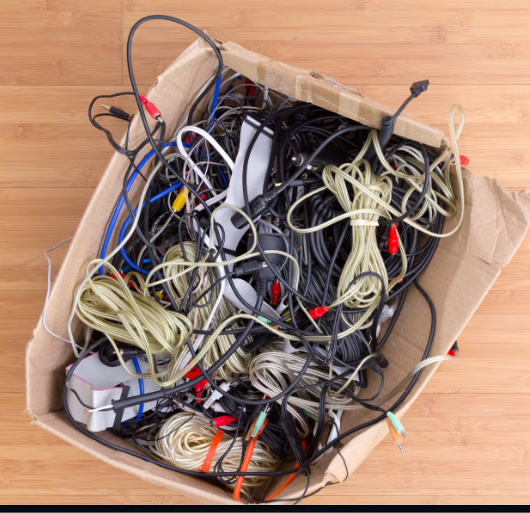
Be honest. Somewhere in your house is a box, drawer or plastic bag filled with cords you can't identify.
There’s the charger for a phone you haven't owned in eight years. A cable that probably belonged to an old printer. A mysterious black power adapter. Three identical USB cables. And, somehow, a cord for a device you don't even remember owning.
You're not alone.
A 2020 Wall Street Journal article captured the phenomenon perfectly: electronics disappear, but their cords seem to live forever. One family interviewed for the article had moved a box containing 20 to 30 cords from home to home without ever actually using most of them.
The funny part is that the box isn't really just about clutter.
It is a small example of a much bigger problem: electronic waste.
From the Garage to a Global Waste Problem
Our technology changes constantly.
Phones get replaced. Computers become obsolete. Internet providers send new routers and modems. Printers stop working. Old televisions get upgraded. And suddenly, the electronics that once seemed essential become something we don't know what to do with.
The United Nations estimates that the world generated 62 million metric tons of electronic waste in 2022, and only about 22% was documented as properly collected and recycled. By 2030, global e-waste is expected to reach 82 million metric tons.
That's a lot of old phones, computers, appliances, televisions, cables and other electronics.
And unlike ordinary household waste, electronics contain a strange contradiction: they can be both waste and a valuable source of materials.
Your Old Phone Is Worth More Than You Think
Inside an old phone are materials that took significant resources to extract and manufacture in the first place.
There is copper. Aluminum. Glass. Plastics. And small quantities of precious metals including gold, silver and palladium.
According to the U.S. Environmental Protection Agency, recycling one million cell phones can recover approximately 35,000 pounds of copper, 772 pounds of silver, 75 pounds of gold and 33 pounds of palladium.
So that old phone sitting in your junk drawer isn't necessarily worthless.
It is a tiny collection of materials that could potentially become part of something new.
And Then There Are the Cords
Cords may seem even less important.
After all, who cares about an old charging cable?
But cables contain materials such as copper that can be recovered. The challenge is getting them into the right waste stream in the first place.
Many people don't know where old cords belong. They aren't necessarily accepted in curbside recycling, and tossing electronics into the regular trash can create environmental and safety problems.
That leaves people with a familiar dilemma:
Keep the cord forever, or throw it away and hope you never need it again?
The answer doesn't have to be either.
Depending on the condition and type of cable, reuse or donation may be possible. When a cord or electronic device truly reaches the end of its useful life, look for a local electronics recycling program or a retailer that accepts electronic waste.
What About That Old Modem?
Here's another one most people can relate to.
Your internet company upgrades your equipment. The new modem or router arrives. The old one gets unplugged and tossed into a closet.
Then it moves to the garage.
Then the basement.
Then another box.
Eventually, nobody remembers what it does.
The same thing happens with old keyboards, computer monitors, tablets, printers, gaming consoles and phones.
The problem isn't simply that we have too much technology.
It's that technology is entering the waste stream faster than many people realize.
The Circular Economy Starts With Knowing What's There
The good news is that electronics don't necessarily have to follow a straight line from store → home → trash.
They can follow a different path:
Buy → use → repair → reuse → refurbish → recover materials → make something new.
That's the idea behind a circular economy.
The longer a product stays in use, the more value we can get from the resources that went into making it. And when a product finally reaches the end of its useful life, recovering its materials can reduce the need for new raw materials.
That requires more than recycling bins.
It requires better collection systems, better sorting and, increasingly, better data.
Waste operators and recyclers need to understand what materials are entering their facilities, where those materials are coming from and what happens to them after collection.
Technology can help make that process more visible.
At Bond4Waste, we're interested in exactly that intersection of technology, data and waste. Better information can help waste operations understand their streams, identify opportunities and make smarter decisions about what happens to materials once they leave our homes.
So, What Should You Do With the Box?
Before throwing everything away, take a few minutes to sort it.
Keep what you actually use.
Donate or reuse what still has a purpose.
And for electronics that have reached the end of their useful life, find an appropriate electronics recycling option rather than putting them in the regular trash.
You might even discover that you don't need that 14-year-old printer cable after all.
Or maybe you do.
Because, as anyone who has ever needed a strangely specific cord at 10 p.m. knows, the moment you throw away the last one is usually the moment you need it.
But the next time you look at that box of mystery cables, think beyond the clutter.
It's not just a box of old technology. It's a box of materials that could have another life.
Related reading
“We Have Enough Clothing”: Our Outreach Director’s Firsthand Account from the United Nations
The following is a firsthand account from Bond4’s Outreach Director, a former U.S. diplomat who served at the U.S. Mission to the United Nations in New York. During her posting, s…
Documentary Review: "Buy Now!" Reveals the Hidden Cost of Our Shopping Addiction
Continuing on the theme of textile overproduction and waste, as mentioned in our last newsletter , we wanted to take a closer look at a documentary that asks a bigger question: Wh…
Battery Dumping Is Becoming a Growing Threat to Waste Operations
Most people don't think twice before tossing something into the trash. For waste collection crews and recycling facilities, however, a single misplaced item can have serious conse…