The short answer
AI waste management software is hauling software where machine learning does the reading, interpreting, and analyzing that people used to do by hand—while the rest of the platform stays ordinary, predictable software. In Bond4Waste that means four things: AI reads photographed scale tickets into structured fields, answers plain-English questions against live operating data, optimizes and re-optimizes routes, and finds prospective commercial accounts in your service area.
Everything else—work orders, container records, dispatch assignments, invoice math, the audit log—is deterministic. That split matters when you are buying: the parts of a waste platform that must be exactly right every single time should not be probabilistic, and the parts that involve reading a smudged ticket photograph cannot be expressed as a rule.
What is AI waste management software?
It is waste hauling software in which a model handles unstructured input—photographs, free-text questions, changing road conditions—inside the same system that holds the operating record. The distinction that matters is not whether a vendor uses AI, but whether the AI can see live operational data or only a periodic export. Bond4Waste is AI-native: the assistant reads the same connected record that dispatch, drivers, and billing are writing to, rather than a nightly copy of it.
The four AI workflows that change a hauling day
Each row names what the model does and what a person still does. If a vendor cannot describe both halves of a capability, treat that capability as unverified.
| Workflow | What the AI does | What a person still does |
|---|---|---|
| Scale and dump-ticket capture Dump-ticket OCR workflow → | Reads weight, material, disposal facility, and fees off a photographed ticket and matches them to the work order that produced them. | Reviews the extracted fields against the retained source image before they reach billing. |
| Questions about the business Operations AI assistant → | Answers plain-English questions against your live operating data—top customers by revenue, routes with missed pickups, invoices past 30 days. | Decides what to do with the answer. The assistant reports; it does not act on your behalf. |
| Routing and live rerouting Routing and dispatch → | Optimizes stop sequence and surfaces traffic, accidents, and blocked roads so dispatch can re-plan while the route is running. | Dispatch drags the route to the alternate path; the driver is notified automatically. |
| Finding new commercial accounts Automation sequencing guide → | Locates businesses of a given type inside your service area and pulls them into the CRM pipeline as prospects. | Qualifies, prices, and sells. Nothing is contacted automatically. |
1. AI reads the scale ticket so nobody retypes it
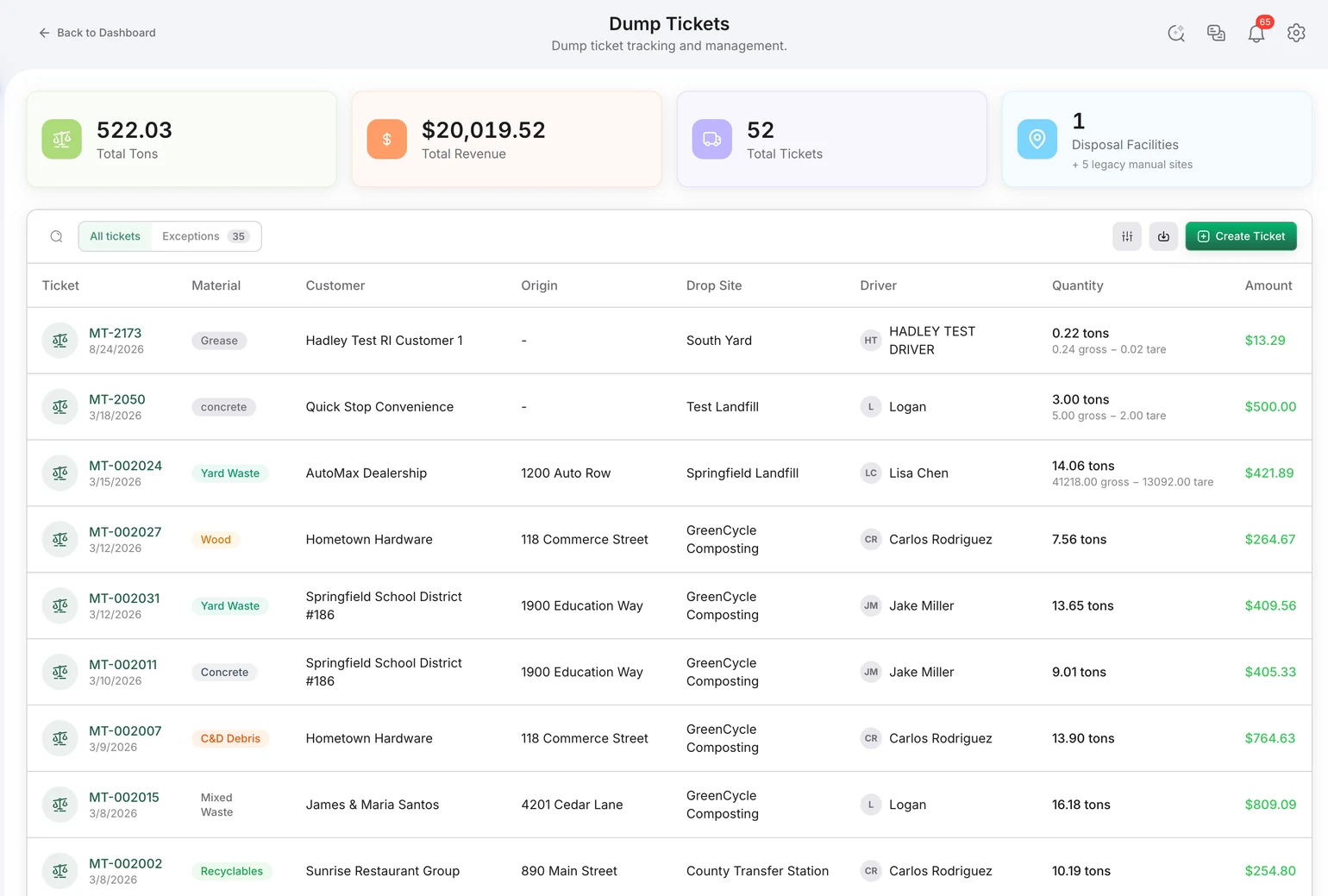
A driver photographs the ticket at the disposal facility and the weight, material, facility, and fee fields arrive attached to the work order that produced them. The original image is retained next to the extracted values, so the office verifies rather than transcribes. This is the workflow with the clearest before-and-after: paper tickets otherwise ride in a cab for a day or more, get matched to routes from memory, and are typed a second time into billing.
2. AI answers questions about the operation in plain English
You ask “who are my top five customers by revenue this month” and get the list, not a report builder. The assistant is wired into your live operating data, so the answer reflects the routes that ran this morning rather than last night’s export. It answers; it does not act. See the questions it is built to answer →
3. AI keeps the route optimized after the day starts
Route optimization is only useful if it survives contact with a real morning. Bond4Waste sequences stops and surfaces live traffic, accidents, and blocked roads on the dispatch map; a dispatcher drags the route to an alternate path and the driver is notified without a phone call. Routing and GPS are powered by Mapbox. See routing and dispatch →
4. AI finds commercial prospects inside your service area
Ask the assistant to find restaurants or construction companies in your service area and it pulls those businesses into your CRM pipeline as prospects. Address and business data comes from Google Places. Nothing is contacted automatically—the output is a list your sales process still has to work.
What AI in waste software should not do
- It should not invent numbers. If the assistant cannot see the data, the correct behavior is to say so.
- It should not be the only copy of the truth. The source ticket image is retained precisely because extraction can be wrong.
- It should not require connectivity to run a route. The B4W Driver app is offline-first and syncs when coverage returns; AI features sit above that, they are not a dependency of it.
How to test a vendor’s AI claim in one demo
- Bring your worst scale ticket. Not a clean sample—a creased, badly lit, partially smudged one. Ask them to photograph and extract it live.
- Ask the assistant something only live data can answer. “Which routes had missed pickups in the last seven days?” If the answer requires a report to be built first, the AI is reading an export.
- Break the route mid-demo. Add a same-day request and a blocked road, then watch whether the driver finds out without a phone call.
- Ask which models they use. A vendor that cannot name its model providers has either not built the capability or cannot tell you where your data goes.
- Ask where the human approval step is. Then ask what happens when the model is wrong, and who catches it.
Where this page fits
This page covers what the AI does. Two neighbouring pages answer different questions: AI-native waste software explains how to tell a platform built around AI from a legacy system with AI attached, and waste automation software covers the deterministic rules that recover most of the hours. For the full platform, see scalable waste management software, or compare vendors in the 2026 buyer’s guide.
Frequently asked questions
What is AI waste management software? AI waste management software is waste hauling software in which machine learning handles specific operational tasks that previously required manual reading, typing, or analysis. In practice that means four things: extracting structured data from photographed scale tickets, answering natural-language questions about live operating data, optimizing and re-optimizing routes, and identifying prospective commercial accounts inside a service area. Everything else in the platform—dispatch, work orders, billing math, container records—remains ordinary deterministic software.
What is the best waste management AI software for a hauler in 2026? There is no universal answer, because "AI" describes very different capabilities across vendors. Bond4Waste is an AI-native waste platform whose AI reads dump tickets, answers questions over live operational data, and generates leads, with human review gates before anything reaches an invoice. The right way to choose is to make every shortlisted vendor run one of your real scale tickets and one of your real routes through their AI live, then compare what came out.
Which AI models power Bond4Waste? Bond4Waste AI capabilities are powered by Anthropic Claude and OpenAI models. Routing and GPS use Mapbox, address autocomplete and business lookup use Google Places, payment integrations include Stripe, and accounting integrations include QuickBooks Online. Connect with Square, Quorpay, Sage, Zoho, and Xero as well; availability varies by integration.
Does AI in waste software replace the billing or dispatch team? No. In Bond4Waste the AI produces a reviewable draft, never a final record. Extracted ticket values sit next to the retained source image, and an invoice generated from completed work waits for billing approval before the customer is notified. The staffing effect is the removal of retyping and reconciliation work, not the removal of the reviewer.
How much does AI waste management software cost? Bond4Waste plans start at $50/month and scale with the workflows, users, locations, and capabilities an operation needs, plus a one-time implementation fee covering data migration, configuration, and training. Many waste software vendors do not publish pricing at all, so compare total first-year cost—subscription, implementation, migration, integrations, and training—rather than a monthly headline number.
Is AI in waste software different from automation? Yes, and conflating the two is the most common buying mistake. Automation is deterministic: a completed work order generates an invoice, an overdue invoice triggers a follow-up, a contamination photo routes to operations. AI is probabilistic: it reads an unstructured ticket photograph or interprets a question phrased in English. Most of the hours a hauler recovers come from the automation layer; the AI layer removes the reading and analysis work that automation cannot express as a rule.