What is portable toilet route software?
Portable toilet route software is an operating system for a fleet of units that live at customer sites. It answers four questions continuously: where is every unit, which units are due for service, did the visit actually happen, and what should be billed. Operators who also pump septic, grease, or holding tanks add a fifth question — where did the load go, and what did disposal cost.
That is a different problem from a scheduling calendar. A calendar says a truck is supposed to be somewhere. A route operations platform says which of your 900 units was serviced this morning, by whom, in what condition, and whether the customer has already called about it.
One route, several different jobs
Portable sanitation is unusual because delivery, service, and removal all happen on the same route, sometimes at the same site. A system that only understands “stop completed” throws away the distinction that drives inventory and billing.
| Job type | What the driver does | What has to reach the record |
|---|---|---|
| Delivery | Place units at a new site and confirm positioning | Unit identifiers, site location, placement photo, timestamp |
| Service in place | Pump, clean, restock, note damage or tipping | Which unit was serviced, condition notes, photos, restock detail |
| Pickup | Remove units at end of rental and return them to the yard | Units off site, condition on return, inventory back to available |
| Relocation or swap | Move a unit within a site or to a different site | The new location written to the unit record, not a sticky note |
| Emergency or extra service | An unscheduled visit outside the regular cycle | Reason for the visit and whether it is billable |
Every unit is an asset with a location and a service clock
Bond4Waste tracks containers and equipment as assets with a current location and a full service history. For a portable sanitation fleet, that asset record is where a restroom unit, hand-wash station, holding tank, or restroom trailer lives. It is how you answer “how many units are actually on rent right now” without counting rows in a spreadsheet that was last accurate in April.
This is the same mechanism that lets roll-off haulers know where every box is sitting. If you also run containers, the parallel is exact — see roll-off dumpster software for the container version of the same workflow.
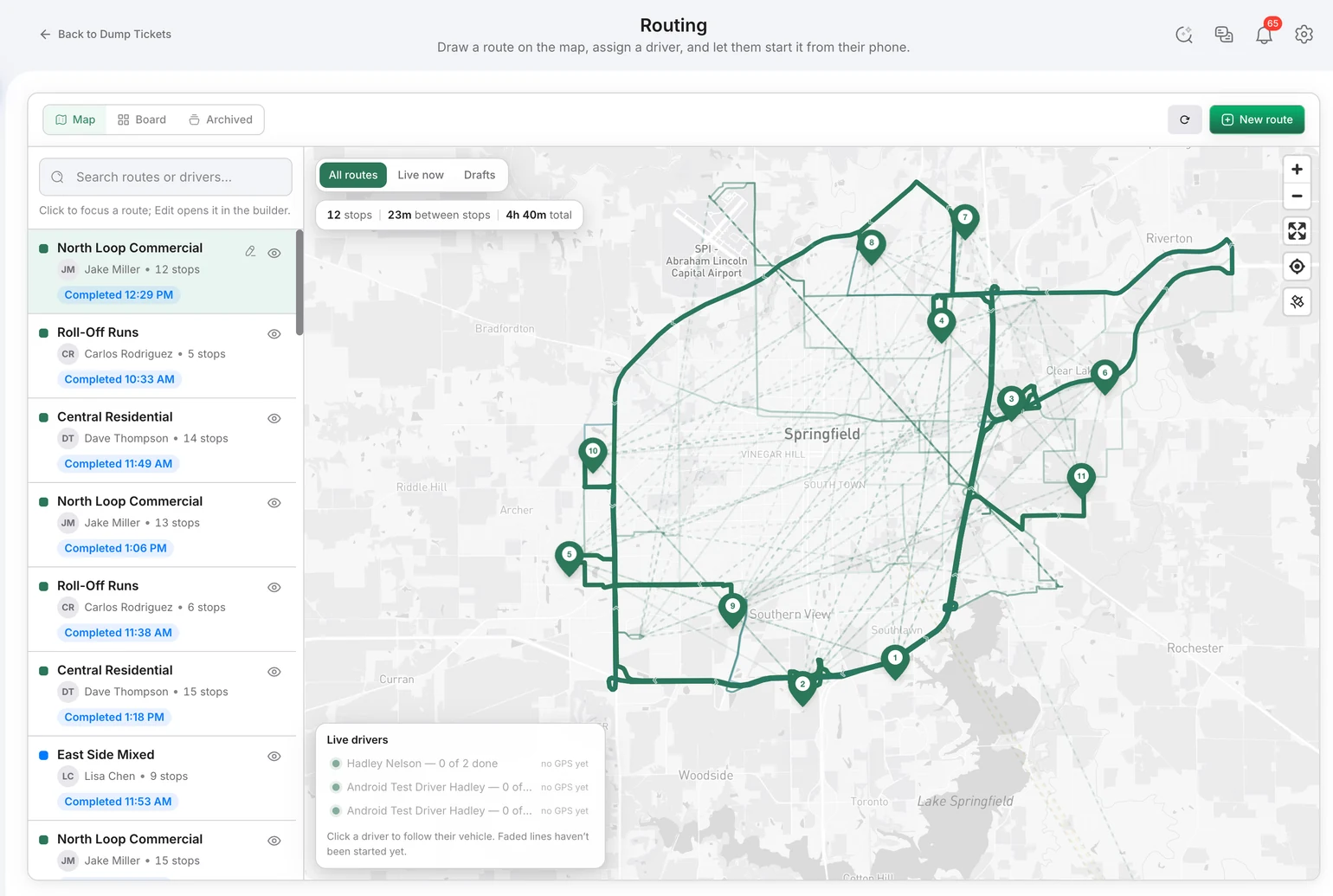
Pumping work: the load has to land somewhere
A pumping route is not finished when the tank is empty — it is finished when the load is disposed of and the receipt is attached to the job. Bond4Waste captures disposal tickets in the field: the driver photographs the ticket at the receiving facility and OCR extracts the operating fields, so the ticket becomes reviewable data instead of a slip in the door pocket. The original image is retained next to the extracted values.
The capture step is described in detail on the dump ticket and scale ticket OCR page. Ticket formats vary between treatment plants, transfer stations, and landfills, so confirm which fields the extractor reads on your receiving facility’s ticket before relying on it for volume-based billing.
Event work and construction work are two different businesses
The same fleet serves two rhythms that pull in opposite directions. Event work is a short, dense burst: a large unit count delivered on a fixed date, serviced once or not at all, pulled the following Monday, invoiced as a single job. Construction work runs for months at a handful of units per site, on a weekly service cycle, with unit counts that change as the job phases and an invoice every month.
Bond4Waste handles both as scheduled work against customer and site records — recurring service schedules for the ongoing accounts, one-off work orders for the event build and teardown. Service zone management keeps route density manageable as the mix shifts through the season.
Where the answer lives
| Question you get asked | Where Bond4Waste answers it |
|---|---|
| How many units are on rent right now? | Asset records with current site and status |
| Which units are due for service this week? | The route schedule built from each account’s service frequency |
| Did we actually service that unit on Thursday? | Timestamped, GPS-located completion with photos and notes |
| Where did last night’s load go? | The disposal ticket attached to the job that produced it |
| What do we invoice this event customer? | An invoice generated from the completed work orders |
| Why is the customer disputing this charge? | The connected service record, including the field photos |
What to verify before you buy
A vendor page that claims a perfect fit for every trade is not telling you anything. Bring these to a demo and make the platform show you:
- Volume capture. If you bill pumping work by the gallon, confirm exactly where gallons are entered and how they reach the invoice.
- Per-unit service frequency. Confirm how weekly, twice-weekly, and on-call cycles are configured per account and per site.
- Unit attributes. Confirm which restroom-specific attributes live on the asset record and which you would keep elsewhere.
- Route density. Run your busiest summer Saturday through the dispatch board, not a demo route with twelve stops.
Related workflows
See the dispatch layer underneath all of this in waste routing and dispatch software, the full platform in scalable waste management software, or start vendor research with the 2026 buyer’s guide. For the category view across every trade that runs on routes, see route-based service software.
Frequently asked questions
What is portable toilet route software? Portable toilet route software is an operating system for a portable sanitation fleet. It tracks where every unit is, schedules the delivery, service-in-place, and pickup visits each unit needs, gives drivers that work on a phone, records proof that each visit happened, and carries the completed work into billing. Bond4Waste provides this workflow as route-based service operations software.
Can one system handle both portable restrooms and septic pumping? Yes, when the system is built around routes, assets, and disposal records rather than a single service type. Bond4Waste treats a portable restroom service stop and a septic pumping stop as work orders on a route, each with its own completion record, photos, and disposal ticket where one applies. An operator running both lines of business uses the same dispatch board, driver app, and billing workflow for each.
How does a driver prove that a unit was serviced? The driver completes the stop in the native B4W Driver app, which records the completion with a timestamp and GPS location and lets the driver attach photos and notes. That record stays attached to the customer, the site, and the invoice, so a disputed service call is answered from the record instead of from memory.
How is unit inventory tracked between the yard and job sites? Bond4Waste tracks containers and equipment as assets with a current location and a service history. For a portable sanitation fleet, that is where a restroom unit, hand-wash station, holding tank, or restroom trailer lives: what is on rent, what is in the yard, which site it sits on, and when it was last serviced.
Does Bond4Waste have portable sanitation customers today? Bond4Waste is route-based service operations software, and its customer base today is waste hauling and municipal collection. This page describes capability and operational fit for portable sanitation and septic work, not a track record in that trade. The honest way to evaluate it is a demo run against one of your own routes, from unit delivery through service, pumping, disposal ticket, and invoice.