What makes snow removal dispatch different from a normal route?
A scheduled route spreads a known workload across known days. A snow event collapses the entire customer book into a single window. Two hundred sites that are usually spread across a month all become due between midnight and 7 a.m., and every one of them has the same completion deadline: before people arrive.
That inverts the usual software requirement. Route optimization matters less than the ability to activate a full book instantly, see which sites are finished while the storm is still running, and re-cut assignments when a truck breaks down at 3 a.m. with sixty sites left on it.
The callout: turning a decision into assigned work
The trigger decision belongs to a person, not to software. Someone reads the forecast against the trigger language written into each contract and decides the event is on. Everything after that is operational, and that is the part a platform should compress from an hour of phone calls to a few minutes on a dispatch board.
- The trigger decision. A person decides the storm meets the contractual trigger. Bond4Waste does not make that call; it is where the decision becomes assigned work.
- Building the event. The sites due for service are created as work orders against their customer and site records and grouped into routes by zone.
- Assigning crews and equipment. Work is assigned to drivers and vehicles on the dispatch board, and each assigned driver sees their sites in the mobile app.
- Running the storm. Dispatch watches live vehicle locations and site completion, reassigns work by dragging it, and messages drivers without a phone call.
- Closing each site. The driver completes the site with a timestamp, GPS location, photos, and notes, and logs materials or expenses used.
- Billing the event. Completed work generates invoices for billing review, and the event record remains available if a claim or dispute arrives months later.
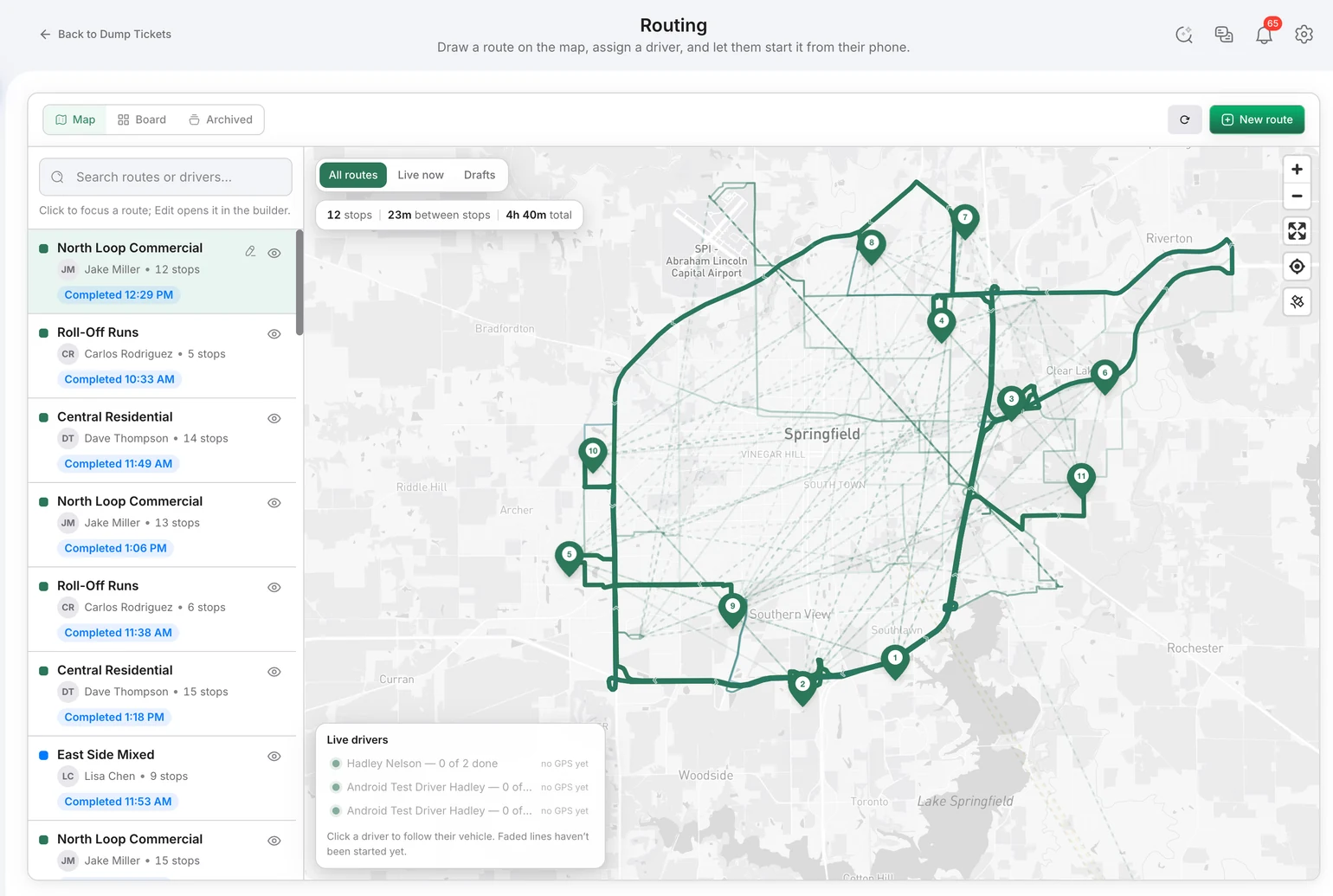
Site-level proof is the whole argument later
Snow removal is documented for two audiences who both want the same record: the customer approving the invoice, and whoever asks about site conditions after someone falls. The second audience may show up a year later, long after everyone has forgotten the storm, and will ask precise questions: when was this lot serviced, by whom, what did it look like, and what was applied.
In Bond4Waste the driver closes each site in the native B4W Driver app, recording a completion timestamp and GPS location and attaching photos and notes. Every change across the platform is written to a complete audit log. The app is offline-first, which matters during a storm when coverage is unreliable and nobody has time to retry a sync.
This describes operational documentation, not legal advice. What your insurer or counsel requires is a question for them; the point here is that the record has to exist before it is needed.
Three contract shapes bill from three different facts
| Contract type | How it is priced | What the record has to prove |
|---|---|---|
| Seasonal flat rate | One agreed price for the winter, regardless of event count | Every event must still be recorded, because the customer will ask what they paid for |
| Per push | A price each time a site is serviced | Event count per site, with a defensible completion record for each one |
| Per inch or tiered | Price varies with accumulation band | Accumulation at the site at service time, recorded alongside the completion |
| Time and materials | Labor hours plus materials applied | Arrival and completion times, and material or expense entries from the field |
Bond4Waste generates invoices from completed work with line items, taxes, and totals, holds them for billing review, notifies the customer by email, and accepts payment through the customer portal by card, ACH, or check. Customers, invoices, and payments sync two-way with QuickBooks Online. If your contracts price by accumulation band, confirm in a demo exactly where the accumulation figure is entered and how it reaches the invoice.
Materials, equipment, and the things that get lost
The cost of a storm is labor, materials, and equipment, and materials are the line that most operations reconstruct from memory. The driver app includes expense logging in the field, so material and fuel costs can be captured during the event rather than reassembled from receipts in a glovebox the following week. Vehicle condition is captured through pre-trip and post-trip inspection checklists, which matter more in winter than in any other season.
Two things to confirm rather than assume: how per-site material application quantities are recorded if you bill them, and how subcontracted crews are represented if a meaningful share of your book is subbed out.
The off-season problem
A snow-only system is idle for eight months and relearned every November. That is the practical case for running winter work on route operations software: the same customers, sites, dispatch board, driver app, proof-of-service record, and billing workflow stay in use through the rest of the year for scheduled service work. The winter book and the summer book share one customer record instead of two systems and a spreadsheet reconciling them.
What to confirm before the first storm
- Activation speed. Time it. From decision to every driver having assigned sites, how many minutes and how many clicks?
- Reassignment under load. Simulate a truck going down mid-event with sixty sites left and watch what dispatch has to do.
- Accumulation capture. If you bill per inch, confirm where the number is entered and how it reaches the invoice.
- Subcontractors. Confirm how subbed crews are assigned, tracked, and reconciled if you use them.
- Record retention. Confirm how long completions, photos, and audit history are retained against the claim window you actually face.
Related route operations
The closest neighbour is street sweeping software, which shares the municipal contract and proof-of-service shape on a fixed schedule instead of a trigger. If your summer book is grounds work, see landscaping and lawn care software for the other half of the year. The dispatch layer is detailed in routing and dispatch software, the category in route-based service software, and the full platform in scalable waste management software.
Frequently asked questions
What makes snow removal dispatch different from a normal service route? Scheduled routes spread a known workload across a known number of days. A snow event does the opposite: the entire customer book becomes due at the same moment, usually overnight, with a completion deadline set by when tenants and employees arrive in the morning. The software problem is not sequencing a day, it is activating a whole book of sites at once and tracking which ones are finished while the storm is still running.
Does snow removal software decide when to dispatch? No, and be skeptical of anything that claims to. The trigger decision belongs to a person reading the forecast against the trigger language in each contract. What software should do is turn that decision into assigned work quickly, show which sites are done while the event is running, and produce a record afterwards. Bond4Waste does the second part; it is not a weather service and does not automate the trigger.
What proof should a snow contractor capture at each site? At minimum: arrival and completion timestamps, the GPS location where the work was completed, the operator and vehicle assigned, photos of the site condition, notes on anything obstructed or deferred, and any material applied. Snow work is documented for two audiences — the customer approving the invoice, and whoever asks about site conditions after an injury claim. Both want the same record.
How are per-push and seasonal contracts billed differently? They bill from different facts. A per-push contract bills from the count of completed service events per site, so the completion record is the invoice. A seasonal flat contract bills on an agreed schedule regardless of event count, but the event record still matters because it is what the customer reviews when they judge renewal value. Per-inch contracts add accumulation at the time of service as a billing input.
Can the same platform run summer work in the off-season? That is the practical argument for running snow on route operations software rather than a winter-only tool. Bond4Waste is route-based service operations software: the same customers, sites, dispatch board, driver app, and billing workflow support scheduled service work in the other three seasons. A snow-only system is idle for eight months and re-learned every November.