What makes junk removal different from a collection route?
A collection route is a known list of stops with a predictable duration. A junk removal day is a set of guesses that get corrected on arrival. The customer described a garage; the crew finds a basement. One job runs ninety minutes long, a same-day booking lands at 11 a.m., and the truck is full two jobs before you planned a disposal stop.
Every operational requirement in junk removal follows from that: dispatch has to be editable mid-day, the crew has to be able to change the price on site with evidence, and the truck has to be able to visit more than one disposal facility on the same load.
How a junk removal job moves through the system
- Booking and scheduling. The job is created against a customer and address with an arrival window, then placed on a route rather than a loose calendar entry.
- On-site assessment. The crew sees the job detail on the phone and captures what is actually there with photos and notes before the truck is loaded.
- The haul. The job is completed in the driver app with timestamp, GPS location, photos, and a signature where the customer is present.
- Disposal. Each disposal stop produces a ticket. The driver photographs it and OCR extracts weight, material, facility, and fees, keeping the ticket attached to the load.
- Invoice and payment. Completed work generates an invoice for billing review and approval. The customer is notified by email and can pay through the billing portal by card, ACH, or check.
The price is set at the curb, not in the office
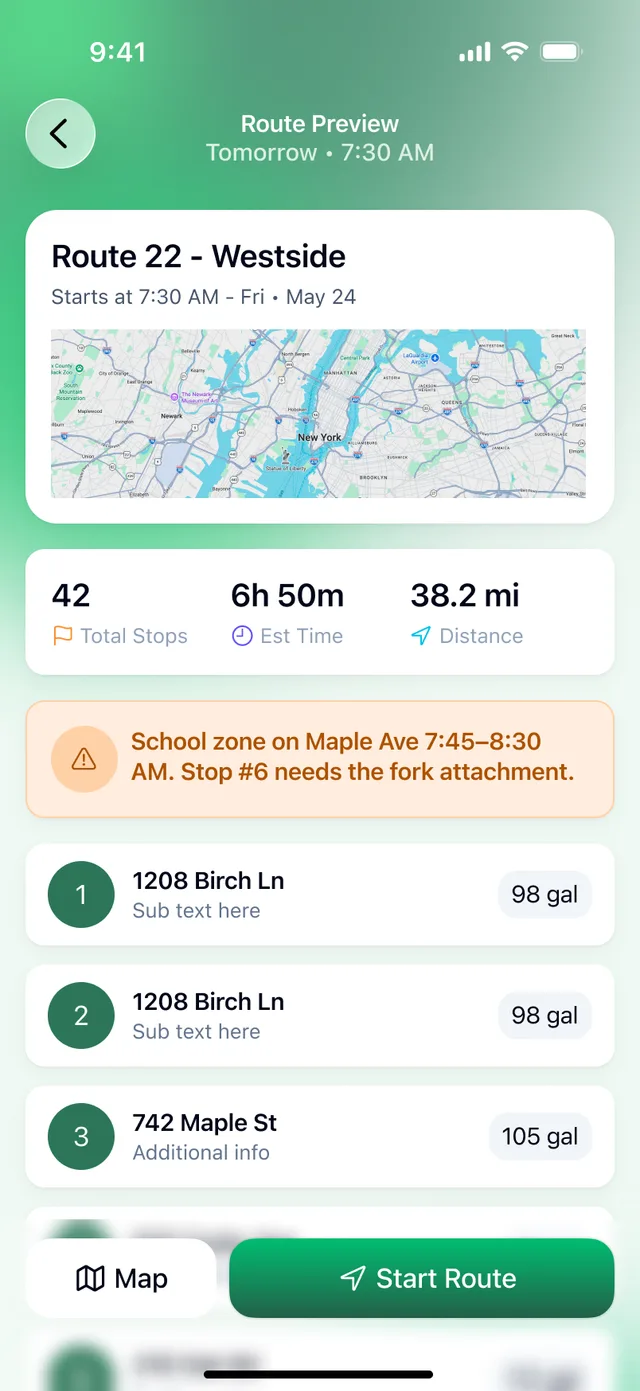
Junk removal is one of the few hauling businesses where the final price is determined by the person doing the work, in front of the customer. That makes the field record the pricing record. In Bond4Waste the crew works the job in the native B4W Driver app: they see the job detail, capture photos and notes on what is actually there, complete the job with a timestamp and GPS location, and collect a signature where the customer is present.
The app is built offline-first, which matters more here than on a scheduled route — junk work runs in basements, parking garages, and rural properties where coverage disappears. Work continues and syncs when the connection returns.
A junk removal day reshuffles itself
Dispatch software for junk removal has to assume the plan is wrong by mid-morning. Bond4Waste dispatchers work from a live map with vehicle locations and route progress, see traffic and road closures, and reassign work by dragging it — the driver is notified automatically instead of receiving a phone call. When a job runs long, the office can see what it does to the rest of the day before the customer calls to ask where the truck is.
The general dispatch workflow is covered on the routing and dispatch page. If a portion of your work is really container work in disguise, roll-off dumpster software covers the delivery-and-pickup side.
One truckload, several destinations
Junk removal is the only hauling trade where a single load routinely splits across four facilities. Mattresses go one place, metal another, usable furniture to a donation partner, and the remainder to a transfer station or landfill. Each stop produces its own ticket and its own fee, and the true disposal cost of the job is the sum of all of them.
| Disposal stop | What the ticket carries | Why it matters to the job cost |
|---|---|---|
| Transfer station or landfill | Weight, material, facility, tipping fee | Usually the largest single cost on the load |
| Recycler or scrap yard | Weight, material, sometimes a payment to you | Offsets cost, and is easy to lose track of entirely |
| Special waste handler | Item counts and per-item fees | Per-item surcharges that should reach the invoice |
| Donation partner | A receipt rather than a fee | Diversion documentation customers increasingly ask for |
Bond4Waste captures these the same way it captures scale tickets on a waste route: the driver photographs the ticket, OCR extracts weight, material, facility, and fee fields, and the source image is retained next to the extracted values for review. See dump ticket OCR for the full workflow.
From completed job to money in the bank
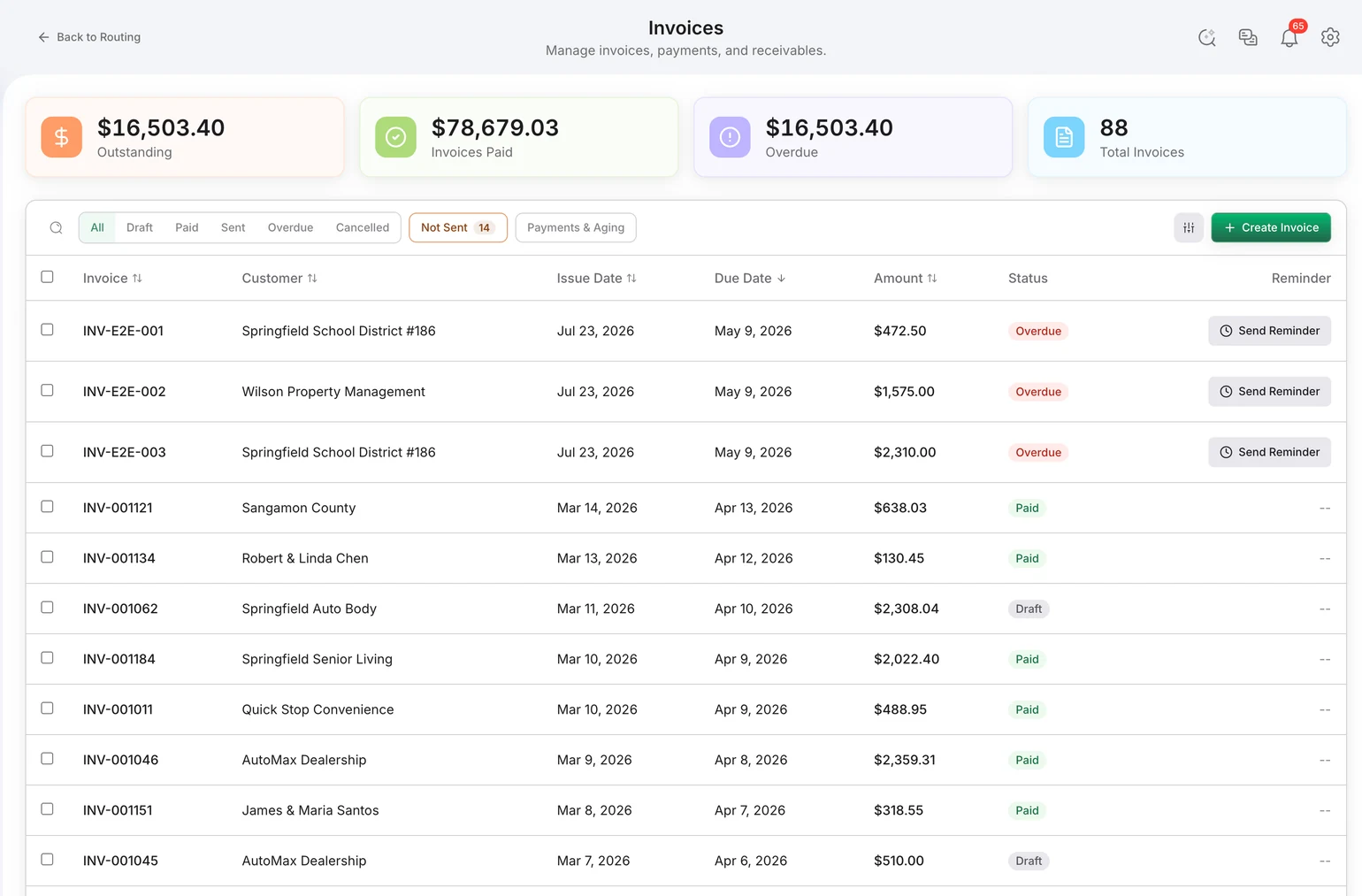
When the job is marked complete, the invoice starts from the work that actually happened. Bond4Waste generates the invoice with line items, taxes, and totals for billing review and approval; the customer is notified by email and can pay through the billing portal by credit card, ACH, or check; overdue invoices trigger automatic follow-up. Customers, invoices, and payments sync two-way with QuickBooks Online, so the office does not enter the same job twice.
Where junk removal needs more than this platform gives you
Bond4Waste is honest about the boundary. Confirm these in a demo rather than assuming:
- Fractional-truckload pricing. If you quote in fractions of a truck, ask how that price is built and stored on the job.
- Two-person crews. Confirm how a crew rather than a single driver is represented on an assignment.
- Consumer booking funnels. The platform includes a customer portal for service requests, not a consumer-marketplace booking widget.
- Item-level catalogs. If you price by item type, confirm where that catalog lives.
Related route operations
Junk removal sits next to portable toilet and septic pumping operations in the way it mixes delivery, service, and disposal on one route. For the category view across every trade that runs on routes, see route-based service software.
Frequently asked questions
What is junk removal software? Junk removal software is a dispatch and job-management system for hauling work that has no fixed duration. It books jobs into arrival windows, assigns them to trucks and crews, gives the crew the job on a phone, records what was hauled with photos and a signature, captures the disposal tickets from every facility the truck visits, and turns the completed job into an invoice.
How is junk removal scheduling different from a collection route? A collection route has a known stop list and a predictable duration, so the plan holds. A junk removal day is built from jobs whose size is only known when the crew arrives, so the plan changes constantly. The software has to handle a job that runs two hours long, a same-day booking added at 11 a.m., and a truck that is full and needs a disposal stop before the next job.
How do you handle multiple disposal stops on one load? Treat each disposal stop as its own record. A single junk removal load can be split across a donation center, a recycler, a transfer station, and a landfill, and each of those produces a separate ticket with its own fees. In Bond4Waste the driver photographs each ticket in the mobile workflow and OCR extracts the operating fields, so the total disposal cost of the load is assembled from real tickets rather than estimated afterward.
How does photo proof protect a junk removal invoice? Volume-priced work is the most disputed kind of hauling invoice, because the customer and the crew are describing a pile from memory. Photos captured in the driver app at completion carry a timestamp and GPS location and stay attached to the job and the invoice, which means a billing question is answered from the record rather than argued.
Is Bond4Waste built for junk removal companies specifically? Bond4Waste is route-based service operations software whose customers today are waste haulers and municipalities. Junk removal shares most of that operational spine, especially dispatch, field proof, and disposal ticket capture. What it does not include is junk-removal-specific pricing tooling such as a fractional-truckload calculator, so confirm how your pricing model is represented before you commit.