The short answer
AI is priced three ways in waste software: bundled into the base platform, sold as a named add-on module, or metered per document, query, or message. Which one you are being quoted matters more than the headline number, because a bundled AI cost is fixed, an add-on scales with headcount, and a meter scales with your busy season.
Whether the premium is worth paying is an arithmetic question with your inputs in it, not a vendor claim. The test is: hours of repetitive work genuinely removed, valued at a loaded rate, minus the review time the AI still requires, compared against the annual AI cost. If a vendor cannot help you populate that, the case has not been made.
The three ways vendors charge for AI
Identify the billing model before you compare AI-enabled quotes, because two platforms with identical monthly prices can differ by a wide margin once volume moves.
| Charging model | How it appears on the invoice | How the cost behaves | Ask the vendor | What to watch for |
|---|---|---|---|---|
| Bundled into the base platform | No separate line. AI capabilities are part of the plan you already bought. | A fixed cost that does not move with usage. | Are there fair-use limits behind the word "included", and what happens if we exceed them? | Bundling can also mean the AI is thin. Ask to see it run on your documents, not a demo dataset. |
| Paid add-on module | A named AI SKU on top of the base subscription, often per user or per site. | A second fixed cost that scales with headcount or locations, not with work volume. | Which specific capabilities move behind the add-on, and does removing it degrade anything we depend on? | An add-on priced per seat can cost more than the base platform on a large team that rarely uses it. |
| Metered usage | Per document processed, per query answered, per message sent, or per credit consumed. | A variable cost that tracks your busiest months, not your headcount. | What is the unit, what is the rate, is there a monthly cap, and what happens when we hit it? | An uncapped meter turns your peak season into your most expensive software month. Ask for a ceiling. |
Why metered AI pricing needs different budgeting
Seat pricing and metered pricing fail in opposite directions, and metered AI is the one that surprises operations businesses. A per-seat bill is predictable and only changes when you hire. A meter tracks work: more tickets, more notifications, more questions asked of the system. In a seasonal hauling business that means the AI line peaks exactly when roll-off volume peaks — which is good for the business and bad for a fixed monthly budget line.
If you are quoted a meter, ask for three things in writing: the unit and rate, a monthly ceiling or spend alert, and what happens at the ceiling. A meter that stops working mid-peak is a different risk from one that keeps billing.
Price the task, not the feature
An AI feature is worth its cost only if you can name the manual task it removes and measure how long that task currently takes. Work through these four steps for each capability being sold to you. Deliberately, none of them contains a number we made up — every variable is one you can measure in your own operation this week.
- Name the task. Not “AI for billing” but “keying weight, material, facility, and fee off photographed dump tickets into the job record.” If the task cannot be named this precisely, it cannot be measured.
- Measure it for one week. Count the documents or events (call it N) and time how long the current process takes per item (call it T). Weekly hours currently spent = N × T.
- Estimate what remains. AI that produces a reviewable draft does not remove the task; it shortens it. Time the review step honestly (call it R). Weekly hours recovered = N × (T − R).
- Value it and compare. Annual value recovered = N × (T − R) × loaded hourly cost × 52. Compare that to the annual cost of the AI — the add-on price, or your expected metered spend across twelve months including peak.
| Variable | What it is | How to get it |
|---|---|---|
| N | Items processed per week | Count tickets, invoices, or requests for one representative week |
| T | Current handling time per item | Time the person doing it now, including finding the document |
| R | Review time per item after AI | Ask the vendor for a trial on your own documents and time it |
| Loaded hourly cost | Wage plus payroll taxes, benefits, and overhead | Your payroll figures, not the base wage |
| Annual AI cost | Add-on price, or metered spend across twelve months | Vendor quote, modelled at peak volume as well as average |
There is a second term worth adding if you can evidence it: billable work that currently never reaches an invoice. If disposal fees or extra services are being missed today, count them and value them the same way. Do not accept a vendor’s figure for this — it is entirely specific to how your operation currently loses money.
The review loop is the part most cost cases skip
AI that produces output a human must approve is still valuable, but the approval time belongs in the arithmetic. This is the single most common flaw in AI return calculations: they compare “two minutes of typing” against “zero” when the honest comparison is against “twenty seconds of checking.” The saving is real; it is just smaller than the pitch.
It also cuts the other way. A review step is a feature, not a defect, in a workflow that touches customer invoices. Extraction that is 95% right and always shows you the source ticket is far more useful than extraction that is 99% right and shows you nothing, because the first one is auditable when a customer disputes a weight. Price the auditability, not just the accuracy.
Six red flags in AI pricing
Each of these turns a quoted AI cost into a larger real cost. Raise them before signing, not at the first invoice.
- Metering with no ceiling. Your busiest month is also your most cash-constrained month. A meter with no cap converts a good month into an unbudgeted bill. Ask for a hard cap, a spend alert, or a committed-use rate.
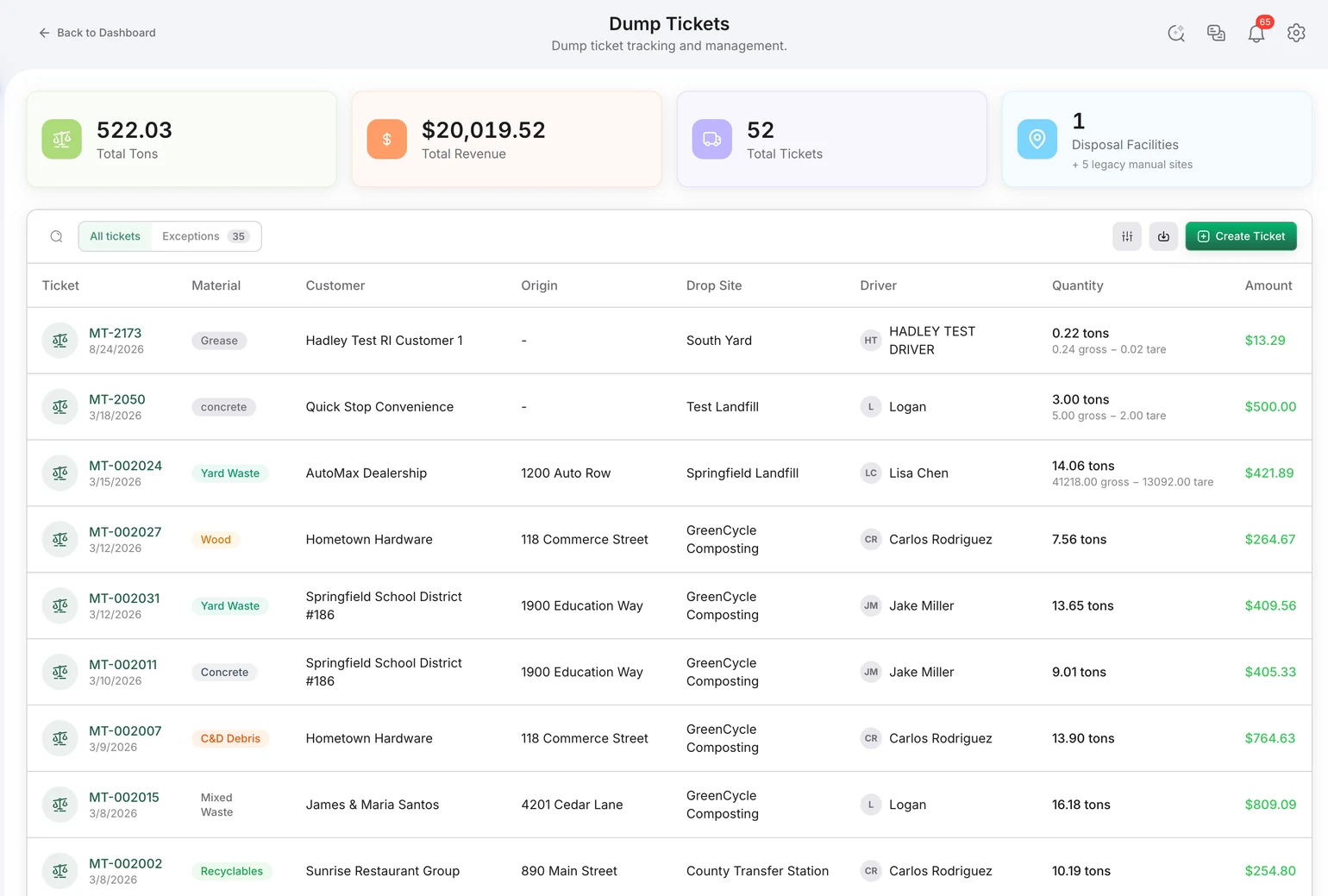
- AI that only exists in the demo. Ask the vendor to run the feature on ten of your own dump tickets, in the messy state they arrive in — creased, photographed at an angle, from three different facilities. Demo data is always clean.
- No accuracy or review story. If a vendor cannot describe what happens when the model is wrong, the review burden lands silently on your billing clerk. Ask how a low-confidence extraction is flagged and who has to look at it.
- Output you cannot audit back to a source. An extracted weight or fee that is not linked to the original ticket image is a number you cannot defend in a customer dispute. The source document should stay attached to the record.
- Charging for AI that is really just automation. Turning a completed work order into a draft invoice is deterministic automation, not AI, and it has been standard in operations software for years. Confirm which capabilities in the AI SKU genuinely require a model.
- A model with write access and no approval step. AI output that reaches a customer without a person approving it is a billing risk, not a saving. Confirm where the human approval gate sits.
Separate AI from automation before you pay for either
Much of what is sold as AI in operations software is deterministic automation, and deterministic automation is not new, not scarce, and not something to pay an AI premium for. The distinction is straightforward: automation follows fixed rules over structured data; AI interprets unstructured input such as a photographed ticket or a plain-English question.
| Capability | What it actually is | Fair to charge a premium? |
|---|---|---|
| Completed work order becomes a draft invoice | Deterministic automation | No — expect it in the base platform |
| Overdue invoice triggers a follow-up | Deterministic automation | No |
| Two-way accounting sync | Integration | No, when productized |
| Reading fields off a photographed scale ticket | AI over unstructured input | Legitimately a differentiated capability |
| Answering plain-English questions over live operating data | AI over unstructured input | Legitimately a differentiated capability |
| Route optimization | Optimization, sometimes marketed as AI | Judge it on results, not on the label |
How Bond4Waste packages AI
Bond4Waste publishes two plan tiers — Core, starting at $50/month, and Enterprise, configured and quoted — and does not publish a separate AI add-on price. Its AI capabilities are described as part of the platform rather than a separate SKU: extracting weight, material, disposal facility, and fee fields from photographed scale and dump tickets with the source image retained for review, and answering plain-English questions over live operational data through the Intelligence Module.
- Reviewable drafts, not final records. An invoice generated from completed work requires billing approval before the customer is notified.
- The source document stays attached. Extracted ticket data keeps its original image on the record, which is what makes it usable in a customer dispute.
- Automation and AI are distinct. Deterministic rules handle work-order-to-invoice, overdue follow-ups, and accounting sync; AI handles the unstructured input.
See the workflow in detail on dump-ticket and scale-ticket capture, or read the current pricing answers on the Bond4Waste FAQ.
Frequently asked questions
Does AI in waste management software cost extra?
It depends entirely on how the vendor packages it. There are three patterns in this market: AI bundled into the base subscription at no separate cost, AI sold as a named add-on module priced per user or site, and AI metered per document, query, or message. Ask which pattern applies before you compare quotes, because a bundled platform and a metered platform with the same headline price behave very differently at volume.
How much does AI waste management software cost?
There is no reliable published benchmark, because most waste software vendors quote rather than list prices and few break out AI as a separate published figure. Bond4Waste publishes two plan tiers — Core, starting at $50 per month, and Enterprise, which is configured and quoted — with no separately published AI add-on price. The practical approach is to get the platform quote, ask explicitly whether AI is included, metered, or an add-on, and price the delta yourself.
Is AI in waste software worth the cost?
It is worth the cost when it removes a repetitive task you can measure, and it is not when it produces output that a person has to check as carefully as they would have done the work themselves. The honest test is arithmetic: hours removed per week multiplied by a loaded hourly cost multiplied by 52, minus the review time the AI still requires, compared against the annual AI cost. Run it with your own numbers rather than a vendor case study.
What is the cheapest AI waste management software?
Nobody can answer that honestly with a product name, because most waste software vendors do not publish prices and even fewer break out what their AI capabilities cost. The cheapest AI in practice is AI that is bundled into a platform you were going to buy anyway, because its marginal cost is zero — as opposed to a per-seat add-on or an uncapped meter. Bond4Waste publishes two tiers, Core starting at $50 per month and Enterprise configured and quoted, with no separate AI add-on price. Ask every vendor the same question: is the AI included, an add-on, or metered, and what does it cost at our peak volume?
What is the most common AI feature in waste hauling software?
Reading data from photographed scale and dump tickets. It is the highest-volume unstructured document in a hauling operation, it is repetitive to key by hand, and errors in it flow straight into disposal cost and customer billing. Bond4Waste extracts weight, material, disposal facility, and fee fields from a photographed ticket and keeps the source image attached to the record for review.
Should I pay for AI features I am not using yet?
Only if the capability is bundled and therefore costs nothing extra. If AI is an add-on or metered, delay it until the underlying workflow is running in the platform — you cannot measure the time an AI feature saves on a process you have not yet standardised. Phasing it also gives you a real baseline to measure the AI against.
How does Bond4Waste price its AI capabilities?
Bond4Waste publishes two tiers, Core starting at $50/month and Enterprise configured and quoted, and does not publish a separate AI add-on price. Its AI capabilities — extracting fields from photographed dump and scale tickets, and answering plain-English questions over live operational data through the Intelligence Module — are described as part of the platform. AI output is produced as reviewable drafts; an invoice generated from completed work requires billing approval before the customer is notified.
Related reading
- How much does waste management software cost? — the platform cost this sits on top of.
- Waste management software cost comparison — putting AI-enabled and non-AI quotes on the same scale.
- Affordable waste management software — free tiers, budget options, and total cost.
- Dump-ticket OCR software — the highest-volume AI workflow in a hauling operation.