What is pest control route software?
Pest control route software converts recurring service agreements into routed work. Every account carries a cadence — monthly, bi-monthly, quarterly, or a commercial schedule of its own — and the software generates the visits due in each window, orders them geographically, hands the day to a technician on a phone, records what happened, and closes the loop into billing.
The distinction that matters: the schedule is derived, not typed. If someone in your office is rebuilding next month’s routes by hand from a customer list, the system is a calendar with a map on it, not route software.
The recurring visit is the unit of work
In a route-based pest operation, the contract is the asset and the visit is the obligation. Revenue is committed in advance across hundreds of agreements, so the operational risk is not winning work — it is failing to deliver visits you have already been paid for, or delivering them so inefficiently that the margin disappears in windshield time.
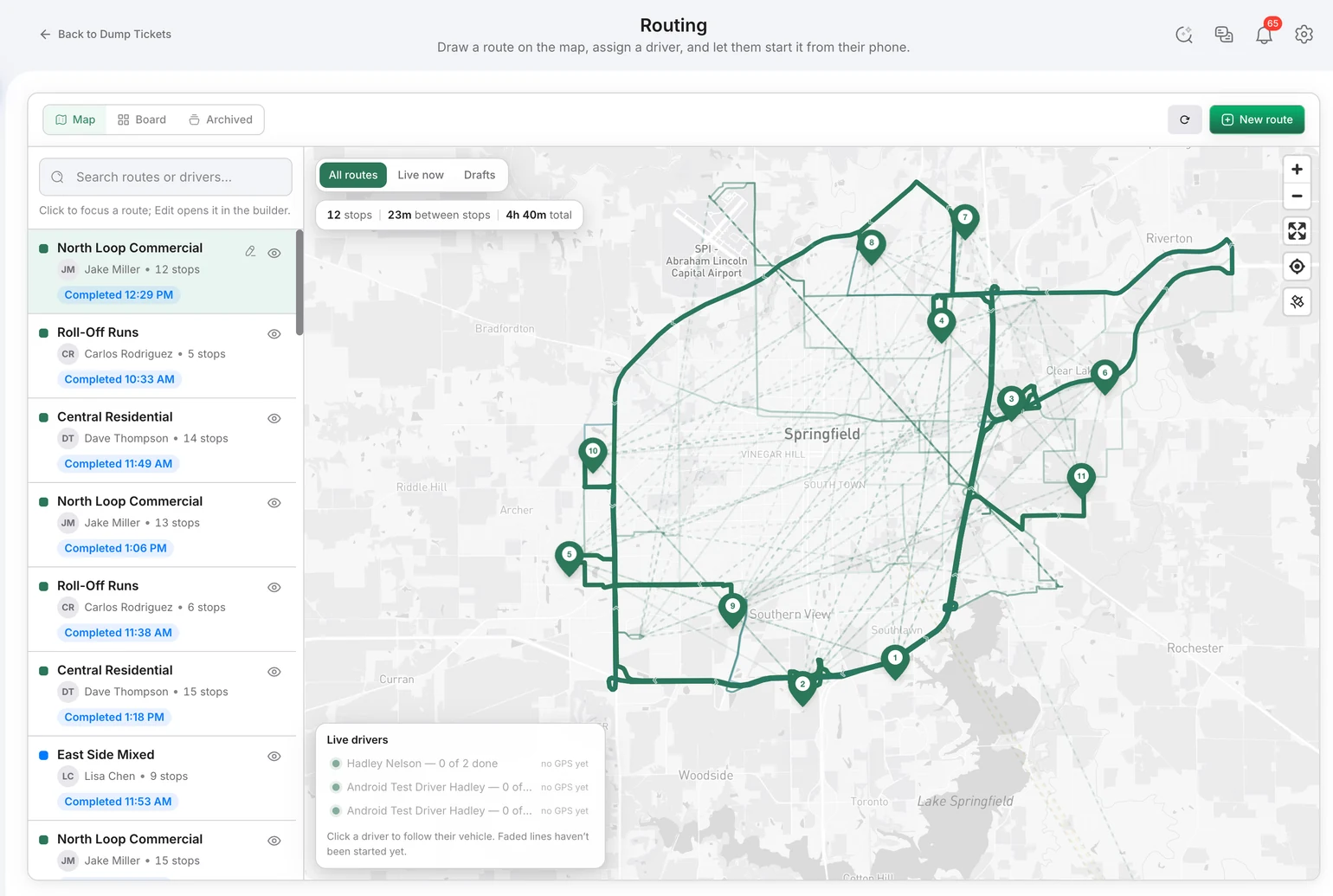
Bond4Waste builds routes from scheduled work against customer and site records, with service zone management to keep territories coherent and route optimization to order the day. Dispatch sees live vehicle locations and route progress and can reassign work by dragging it, with the technician notified automatically.
Route density decides whether the month is profitable
A pest route lives or dies on drive time between stops, not on the length of any single visit. Twenty-two stops in a tight zone and sixteen stops scattered across the county cost the same in labor hours and pay very differently. The scheduling layer therefore has to keep geography and cadence in the same view, so that a new account is sold into a day that already goes past its door.
The same density problem, with the same tooling, is described from the collection side on the routing and dispatch page.
What a technician stop record has to contain
The stop record is the product you are actually selling in a recurring service business. The customer rarely sees the technician; what they see is the evidence that someone came. Here is what has to be on it and where Bond4Waste captures it.
| Field | Where it is captured | What it protects you from |
|---|---|---|
| Account and service location | The work order is created against the customer and site record | Multi-location commercial accounts stay separable at invoice time |
| Arrival and completion timestamps | Captured when the technician works the stop in the driver app | Answers "were you actually here on the 14th" |
| GPS location of completion | Recorded with the completion in the mobile workflow | Distinguishes a real visit from a stop marked done from the truck cab |
| Technician identity | The assigned user on the route, under role-based access control | Ties the visit to the person who performed it |
| Photos of conditions found | Attached in the app at the stop | The evidence for an escalation, a callback, or an added service |
| Notes on what was performed | Entered at the stop and kept on the service history | What the next technician reads before walking in |
| Customer signature | Collected in the app where the account requires it | Commercial accounts and audits frequently ask for it |
The driver app is offline-first, which matters on crawlspace and rural routes: the technician keeps working with no coverage and the record syncs when the connection returns.
Callbacks and re-services are the hardest thing to model
A callback is a real visit that consumes a real hour and produces no invoice, and most systems record it as if it were ordinary work. That single modelling choice quietly destroys your ability to see which accounts, technicians, or service types are unprofitable.
In Bond4Waste a callback is an additional work order against the same customer and site, so it appears on the route and in the service history, and the billing decision is made when the invoice is reviewed rather than assumed at completion. If you need callbacks to be automatically classified, rate-limited by a warranty window, or excluded from technician productivity metrics, put that in front of a demo and make the vendor show you — including this one.
Pesticide application records: verify this before you sign
Federal law requires certified applicators to keep records of restricted-use pesticide applications, and most states add their own recordkeeping obligations for commercial applicators, with fields and retention periods that vary by state. This is the single largest gap between generic route software and a pest control vertical suite, and it deserves a direct answer rather than a marketing sentence.
| Requirement | Bond4Waste today |
|---|---|
| Proof that a visit occurred, when, where, and by whom | Captured — timestamped, GPS-located completion with photos and notes |
| Free-text description of what was performed at the stop | Captured — technician notes on the service record |
| Photographic evidence of conditions found | Captured — photos attached at the stop |
| Structured product, EPA registration number, rate, and target pest fields | Not a purpose-built module — confirm how you would store these |
| State-formatted application reports and retention schedules | Not a purpose-built module — confirm with your state lead agency what is required |
| Chemical inventory and technician license tracking | Not part of the platform — plan for a separate record |
Regulatory summary provided for orientation only. It is not legal advice, and requirements differ by state and by applicator category. Verify current obligations with the EPA and your state lead agency.
Billing a contract, not a visit
Recurring service revenue is billed on a contract rhythm while costs are incurred on a visit rhythm, and the software has to hold both. Bond4Waste generates invoices from completed work with line items, taxes, and totals, holds them for billing review and approval, notifies the customer by email, and takes payment through the customer portal by card, ACH, or check, with automatic follow-up on overdue invoices. Customers, invoices, and payments sync two-way with QuickBooks Online.
Related route operations
The closest neighbour to this workflow is pool service route software, which shares the fixed-cadence route shape and diverges on per-stop readings. The category itself is described in route-based service software. For the underlying platform, see the full Bond4Waste platform, and for vendor evaluation method, the 2026 buyer’s guide.
Frequently asked questions
What is pest control route software? Pest control route software turns recurring service agreements into routed work. It generates each period of visits from every account’s cadence, groups them by geography so technicians are not crossing the territory twice, delivers the day to the technician on a phone, records what happened at each stop, and bills the agreement from completed visits. Bond4Waste provides this as route-based service operations software.
How is a pest control route different from a delivery or hauling route? A pest control route is dense, repeating, and time-boxed per stop. The same 200 to 400 accounts come back on a monthly, bi-monthly, or quarterly cycle, and profitability is decided by drive time between stops rather than by load. The scheduling problem is therefore not "what do we do today" but "which of these recurring obligations are due in this window, and in what order do they make a sensible day."
What should a technician stop record contain? At minimum: which account and site, arrival and completion timestamps, the GPS location where the visit was completed, the technician who performed it, photos of conditions found, notes describing what was done, and a customer signature where one is collected. Bond4Waste captures all of these in the native driver app, and the record stays attached to the account and to the invoice.
Does Bond4Waste handle pesticide application records? Not as a purpose-built regulatory module. Federal law requires certified applicators to keep records of restricted-use pesticide applications, and most states impose additional recordkeeping on commercial applicators, with requirements and retention periods that differ by state. Bond4Waste captures a timestamped, GPS-located stop record with photos and notes, but if you need structured product, EPA registration number, rate, and target-pest fields with state-formatted reporting, confirm exactly how those are stored before you buy, and check your state lead agency for what is required.
Is Bond4Waste a pest control specific platform? No. Bond4Waste is route-based service operations software whose market today is waste hauling and municipal collection. The scheduling, dispatch, mobile field capture, proof-of-service, and billing layers apply directly to recurring pest control routes; the pesticide-specific compliance and chemical-inventory layers that a dedicated pest vertical suite ships are not part of the platform. Evaluate it on that basis rather than on a claim of pest industry pedigree.