Plumbing dispatch is the only part of the trade where software either saves the day or gets out of the way, and there is no middle ground. When a commercial kitchen is flooding, the dispatcher is answering four questions at once: who is closest, who is actually free, who can do this work, and what do we already know about this building. A system that answers those in one screen is worth its subscription. A system that requires three phone calls is a liability.
What is plumbing dispatch software?
Plumbing dispatch software takes a service call, assigns it to a technician, sends the job with its address and history to a phone, tracks the work as it happens, and turns the completed call into an invoice. What separates it from a scheduling app is that it has to work under time pressure with incomplete information, which is the normal condition of a plumbing service board.
Most plumbing companies actually run two boards. One is reactive: emergency and same-day calls that arrive without warning. The other is planned: backflow tests, scheduled drain maintenance, and multi-site commercial contracts that repeat on a cycle. The second board is route work in every meaningful sense, and it is usually the more profitable of the two.
The anatomy of an emergency call
Every minute of an emergency call has a specific information requirement, and the failure is almost always a missing input rather than a bad decision.
| Elapsed | What has to happen | What the system must already know |
|---|---|---|
| 0:00 | Call comes in; the address is identified. | Whether this is an existing customer and which site this is. |
| 0:30 | Dispatcher scans who could realistically get there. | Live position of every service vehicle, right now. |
| 1:00 | Dispatcher checks what breaking that day costs. | Remaining assigned work per technician, and current traffic between here and there. |
| 1:30 | Assignment is made and the customer is given a window. | A realistic travel estimate, not a guess. |
| 2:00 | The technician is notified with the job and site history. | Prior visits, prior findings, and the fixtures involved. |
| On site | Work is done; parts, photos, and notes are captured. | A field record that works with no signal in a basement. |
| Departure | Customer signs; the invoice is generated. | The parts and labor recorded minutes ago, not typed tomorrow. |
| Next day | Billing reviews and releases; the customer pays. | An approval step and a portal the customer can actually use. |
Bond4Waste supports this chain with a live dispatch map showing real-time GPS positions, traffic, accidents, and road blocks; reassignment by dragging a route to an alternate path with automatic notification to the field user rather than a phone call; work order management on the customer record; an offline-first mobile app with photos, notes, and signature capture; and invoice generation from the completed work order with a billing approval step before the customer is notified.
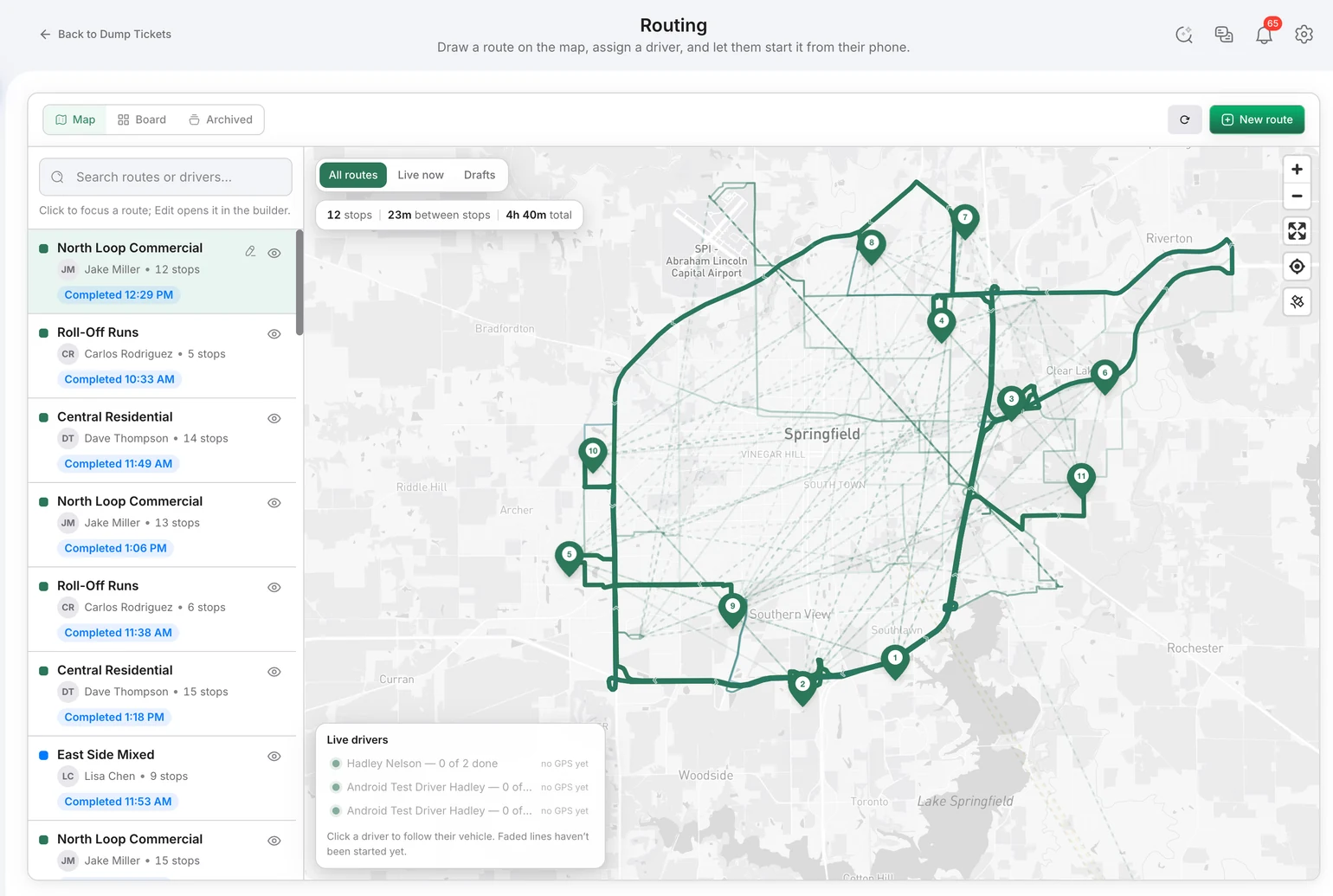
How does dispatch decide who takes the call?
The decision has four inputs, and most dispatch tools supply only two of them.
- Proximity. Not who was assigned to that side of town this morning — where the truck is at this moment. A live GPS map answers this; a schedule does not.
- Remaining capacity. The technician five minutes away with four stops left is a worse choice than the one fifteen minutes away with one. This requires the day’s assigned work to be visible, not just the current job.
- Qualification. Some calls need a specific license, certification, or experience level. If that lives in a dispatcher’s head, the operation cannot scale past one dispatcher.
- Site history. Sending someone who has been to that building before, with the record of what was found last time, is frequently the difference between a one-visit repair and a return trip.
Bond4Waste covers proximity, remaining capacity, and site history directly. Technician qualification matching is not a documented capability — the platform has role-based access with five roles, which is an access model rather than a skills-routing model. If skill-based dispatch is a hard requirement, put it on the demo agenda explicitly.
The building remembers, even when nobody does
In commercial plumbing, the most valuable record is not the customer — it is the address and what has failed there before. A building with three drain calls in eighteen months is a recurring-service conversation, not a fourth emergency. That pattern is invisible when every call closes as a standalone ticket.
Route-based platforms are built around exactly this: a service location with a history of visits, photos, documents, and costs attached to it, plus an audit log recording every change. Bond4Waste includes customer management, work order history, and container and equipment tracking, so a serviceable asset at a site can carry its own record. The honest caveat is naming: those asset objects are shaped for waste containers and fleet equipment today, not for fixtures, mains, or backflow devices. The structure supports what a plumbing service department needs; the labels do not yet speak the trade.
Job-level parts and the flat-rate question
Parts leak out of plumbing jobs faster than any other trade because the work is urgent and the truck is a warehouse. A wax ring, a mixing valve, six feet of PEX — captured at the job, they are revenue; captured tomorrow, they are a guess; not captured, they are a donation.
There are two distinct things people mean when they ask about parts:
- Cost capture at the job. Bond4Waste supports this. The mobile workflow includes expense logging and photographed document capture, and photographed documents are read into structured reviewable fields with the source image retained. It is the same mechanism that keeps a disposal ticket attached to the stop that produced it — see field document capture — and it means a supply-house receipt does not get retyped later.
- A flat-rate price book. Selecting a priced task from a catalog and having it populate the invoice is not a documented Bond4Waste capability. Rate cards exist for billing, but a task-level flat-rate book is a different thing. If your shop sells flat rate, treat this as an open requirement to test rather than assume.
Recurring commercial work is the route half of the business
Scheduled compliance and maintenance work is the most predictable revenue a plumbing company has, and it is pure route work. Annual backflow testing, quarterly drain and grease line maintenance, and multi-site commercial contracts all share the same shape: known addresses, a fixed cycle, a required record, and a renewal that depends on being able to show the visits happened.
| Recurring work type | What makes it route work | What the record has to prove |
|---|---|---|
| Backflow testing | Annual cycle, fixed device locations, cluster-able by geography. | The device tested, the date, the result, and the document produced. |
| Drain and line maintenance | Contracted frequency at commercial sites on a known list. | The visit happened, what was found, and any deferred issue. |
| Multi-site commercial contracts | One customer, many addresses, one schedule to sequence. | Per-site visit history rolled up to a single account. |
| Post-repair follow-up | A scheduled return that should be planned, not remembered. | The link between the original call and the follow-up visit. |
This is the half of a plumbing business where recurring scheduling, service zone management, and route sequencing pay off, and it is where Bond4Waste’s hauling heritage is a genuine advantage rather than a mismatch: recurring service at a known list of addresses is the operation the platform was built to run.
After-hours work and the trail that survives Monday morning
The most expensive plumbing invoices are the ones written from memory on a Monday. After-hours calls generate premium billing and premium disputes, and the record is thin because the technician was tired and nobody was in the office.
Three things captured on site change that outcome: arrival and completion timestamps with location, photographs of the condition found and the work performed, and a signature taken before the technician leaves. Bond4Waste captures all three on the job record from the mobile app, offline if necessary, and writes every subsequent change to a full audit log. The invoice is then generated from that record with a human review step, and the customer receives it by email with card, ACH, and check payment available in the portal — with automatic follow-up if it goes overdue.
Fit assessment: what to expect from Bond4Waste today
Direct fit today
Live GPS dispatch with traffic-aware rerouting and automatic field notification; work order management and scheduling; recurring service schedules and service zones; the offline-first native mobile app with photos, notes, and signatures; expense and document capture at the job; invoice generation with a billing approval step; customer portal payment by card, ACH, or check; automatic overdue follow-up; two-way QuickBooks Online sync; role-based access with a complete audit log.
Present, but shaped for waste today
Asset and equipment records at a service location exist but are modeled and labeled for containers and fleet assets rather than fixtures and devices. The field user role is called driver rather than technician. Neither blocks the workflow; both are visible in the interface and worth seeing in a demo before you decide they do not bother you.
Not documented — ask directly
Flat-rate price book. Skill or certification-based dispatch routing. Permit tracking. Per-truck parts inventory with replenishment. None of these are stated Bond4Waste capabilities, and none should be assumed from a general description of the platform.
How to test plumbing dispatch software properly
Do not evaluate a dispatch board on a calm day. Ask every vendor to run this exact sequence and watch how many phone calls it takes.
- At 2 p.m., with every technician assigned, take a flooding call and place it. Show me the four inputs on one screen.
- Show me what the technician receives, including the history of that address.
- Do the job on a phone in airplane mode. Photos, notes, parts, signature. Then reconnect.
- Follow a part from the truck to a line on the invoice the customer receives.
- Run a year of backflow tests as a schedule and show me the day it produces.
- Show me a building with four prior calls and how long it takes to see the pattern.
- Ask what the platform does not do for plumbing, and judge the answer.
For the model behind this, see AI software for route-based service businesses. For dispatch mechanics in depth, see routing and dispatch software. The trade with the closest scheduling profile is covered on the HVAC field service page.
Frequently asked questions
What is plumbing dispatch software? Plumbing dispatch software is the system a plumbing company uses to take a service call, decide which technician goes, send them the job with the address and history, track the work in the field, and turn the completed call into an invoice. Emergency work is what makes the category distinct: the software has to support a decision made in under two minutes, with the customer still on the phone, without anyone calling three technicians to ask where they are.
How does dispatch software decide which plumber takes an emergency call? Good dispatch software does not decide; it gives the dispatcher the four inputs needed to decide quickly. Those are proximity, which requires live vehicle positions rather than a morning check-in; remaining capacity, which requires knowing what is left on each technician day; qualification, which requires knowing who can do this specific work; and site history, which requires the record of what was done at this address before. In Bond4Waste, live GPS positions and current traffic, accidents, and road blocks appear on the dispatch map, remaining assigned work is visible per field user, and the customer record carries prior job history.
How do parts used on a plumbing job get onto the invoice? They have to be recorded at the job, by the person who used them, before the truck moves. In Bond4Waste the mobile app supports expense logging and photographed document capture at the job, and photographed documents are read into structured, reviewable fields with the original image retained. The completed work order then generates an invoice with line items, taxes, and totals for a billing reviewer to approve. A task-level flat-rate price book is not a documented Bond4Waste capability and should be verified directly.
Is recurring commercial plumbing work route work? Yes. Scheduled backflow testing, grease line and drain maintenance, and multi-site commercial service contracts are recurring visits at known addresses on a fixed cycle, which is the definition of route work. They are usually the most predictable and most plannable revenue a plumbing company has, and they benefit from the same sequencing, service zone, and proof-of-visit capabilities that emergency calls do not need.
Does the mobile app work in a basement with no signal? The native B4W Driver app for iOS and Android is built offline-first, with data cached locally on the device. A technician in a mechanical room, a basement, or a rural service area can continue working normally, and everything syncs automatically when the connection returns. This matters more in plumbing than in most trades because the work happens in exactly the places phones do not have coverage.
Is Bond4Waste built for plumbing contractors? Bond4Waste is route-based service operations software, and its production deployments today are waste and recycling haulers and municipal collection programs rather than plumbing contractors. The dispatch spine a plumbing shop needs is present: live GPS dispatch with traffic-aware rerouting, automatic notification to the field, work order management, an offline-capable mobile app with photos and signatures, cost capture at the job, automated invoicing with human approval, a customer payment portal, QuickBooks Online two-way sync, and role-based access with a full audit log. Plumbing-specific objects such as a flat-rate price book and permit tracking are not documented capabilities.