An electrical contractor runs two operations that look similar on an org chart and behave nothing alike in software. The service board is a stream of short jobs at scattered addresses where sequence, travel time, and same-day dispatch decide the day. The project schedule commits a crew to one address for days or weeks, where the problem is allocating people and material across a calendar. Route-based software is excellent at the first and wrong for the second, and most buying mistakes in this trade come from not naming which one you were solving.
What is electrical contractor software?
Electrical contractor software schedules and dispatches work, assigns crews, tracks labor and material against jobs, captures the field record, and bills. The category is unusually broad because the trade is unusually broad: the same company might run four-hour troubleshooting calls, quarterly facility maintenance, a two-week tenant fit-out, and a generator install, all in one week.
That breadth is why the category splits into two software traditions. Service-first products come from the dispatch world and organize around a call. Project-first products come from construction accounting and organize around a job with a budget, phases, and progress billing. Route-based service operations software is a specialization of the first tradition, tuned for businesses where travel between many addresses is a recurring, sequenced cost.
Fit by work type: where route-based software helps and where it does not
Rate your own revenue mix against this table before you evaluate anything. If more than half your revenue sits in the bottom two rows, the honest recommendation is to look at project-accounting or construction-management software for that portion of the business.
| Work type | Route-shaped? | Why | Fit with Bond4Waste |
|---|---|---|---|
| Service and troubleshooting calls | Yes | Dispatchable, short, address-scattered; travel time is a real cost. | Strong |
| Recurring facility and lighting maintenance | Yes | Known addresses, fixed cycle, per-visit proof, contract renewal depends on the record. | Strong |
| Small same-day install jobs | Mostly | Opens and closes in one visit; sequencing several in a day is the whole efficiency question. | Good |
| Multi-day jobs of three to ten days | Partly | One address, but each day still produces labor, material, and a field record. | Partial — verify how a job spanning days is represented |
| Contracted construction projects | No | Budgets, phases, submittals, change orders, progress billing, and retainage. | Not a fit — use project-accounting software |
Why multi-day jobs break single-stop models
Route software assumes a unit of work opens and closes on the same visit; a multi-day job stays open while producing a separate record every day. That single structural difference causes most of the friction electrical contractors hit with service-first products.
Watch for the two standard workarounds, both of which lose information:
- One work order per day. The daily record survives but the link between days is gone, so nobody can see total hours or total material on the job without exporting and adding them up.
- One work order left open all week. The job survives but the daily record is gone, so there is no proof of which day the crew was on site and no way to catch a day that went sideways until the job closes.
The correct structure is a parent job that stays open, containing a dated record per day of work, each with its own labor, material, photos, and notes. That structure is not a documented Bond4Waste capability today. The platform documents work order management, scheduling, and job records suited to work that completes on a visit. If multi-day job structure is central to your operation, make it the first question in any demo and do not accept a demonstration built on a single-day job.
Crew scheduling is a different problem from stop sequencing
Route optimization answers “what order should one person drive in today.” Crew scheduling answers “which three of my fourteen electricians are committed to which addresses for the next two weeks.” These are different questions and software rarely does both well.
| Question | Scheduling problem | What the software has to hold |
|---|---|---|
| Who takes this service call? | Same-day dispatch | Live position, remaining work today, qualification. |
| What order does the day run in? | Sequencing | Stop list, travel time, service zone boundaries. |
| Who is on the fit-out next week? | Resource allocation | Multi-day availability across the whole labor pool. |
| Can I pull one electrician off the job Thursday? | Reallocation | The effect on both the project and the service board at once. |
Bond4Waste is built for the first two rows. Dispatch sees live GPS positions along with traffic, accidents, and road blocks; a route can be dragged to an alternate path and the field user is notified automatically instead of by phone; and route planning and optimization sequence the day. Multi-week labor allocation across a crew pool is not a documented capability and should not be assumed.
Job costing when the work spans days
The reason multi-day structure matters is not tidiness — it is that a job you cannot cost daily is a job you find out about at the end. A four-day job that used a day and a half more labor than estimated is recoverable on day two and a write-off on day five.
Three cost streams have to land on the job while the crew is still there:
- Labor. Hours by person by day, captured in the field rather than reconstructed from a timesheet on Friday.
- Material. Wire, conduit, gear, and the supply-house run — the receipt has to attach to the job, not to a glovebox. Bond4Waste supports expense logging and photographed document capture in the mobile app, and photographed documents are read into structured reviewable fields with the source image retained. It is the same mechanism that keeps a disposal ticket attached to the stop that produced it; see field document capture.
- Equipment and disposal. Rented gear, and the cost of removing what came out — old fixtures, panels, demolition debris — which is a disposal event with a ticket attached.
Bond4Waste captures material and disposal costs at the job directly. Per-person daily labor capture across a crew, and the roll-up of costs against a multi-day job budget, are the parts to verify rather than assume.
The route work you already have and probably run on a spreadsheet
Most electrical contractors have a recurring-maintenance book they treat as an afterthought, and it is the most route-like, most plannable revenue in the company. Scheduled facility inspections, lighting maintenance across a retail chain, thermal scanning, exit and emergency lighting testing, and generator service all share one shape: a known list of addresses, a fixed cycle, a required record, and a renewal that depends on being able to show every visit happened.
That is precisely the workload route-based operations software was built for. Recurring scheduling, service zone management, and route sequencing turn a list of contracted sites into sequenced days. Completion in the field writes timestamps, location, photos, and signatures to the job record, and that record is what a contract renewal conversation needs. If you run twenty maintenance sites on a spreadsheet and a reminder, this is the half of your business where a route platform pays for itself first.
What Bond4Waste does not do for electrical contractors
Stated plainly, so you can rule it out quickly if these are your requirements. None of the following are documented Bond4Waste capabilities: multi-day job structures with phases or progress percentages; progress billing, AIA-style pay applications, or retainage; change order workflows; submittals and RFIs; estimating or takeoff; multi-week crew allocation across a labor pool; per-person daily labor capture within a crew; skill or license-based dispatch routing; permit and inspection tracking; and per-truck material inventory with replenishment.
The field-user role in the platform is called driver, and asset records at a service location are modeled and labeled for containers and fleet equipment rather than panels, circuits, and fixtures. Neither blocks the service workflow, and both are visible in the interface.
How to evaluate software for an electrical business
Split your revenue first, then evaluate each half against the product built for it. A single system that covers both well is rare, and a system that claims to should be tested hard on the half it talks about least.
- Put a number on the revenue split between service, recurring maintenance, and project work. Everything else follows from that number.
- For the service half: run a live dispatch scenario at 2 p.m. with everyone assigned, and count the phone calls it takes.
- For the maintenance half: load a year of contracted site visits and look at the days it produces.
- For the project half: ask to see a four-day job with three electricians, then ask for total labor and material on that job on day two.
- Follow a supply-house receipt from the phone to a line on the customer’s invoice.
- Test the mobile app in a basement with no signal, then reconnect and confirm what synced.
- Ask each vendor which half of your business they are not built for, and be suspicious of anyone who says neither.
For the general model, see AI software for route-based service businesses. For dispatch mechanics in depth, see routing and dispatch software. The trade with the most similar service-plus-maintenance split is covered on the HVAC field service page.
Frequently asked questions
What is electrical contractor software? Electrical contractor software is the system an electrical company uses to schedule and dispatch work, assign crews, track labor and material against jobs, capture the field record, and bill. Most electrical companies need it to cover two different operations at once: a service board of short calls and recurring maintenance visits, which behaves like route work, and a project schedule of multi-day jobs with crews committed for days or weeks, which does not.
Is electrical work route-based? Half of it usually is. Service calls, small same-day jobs, and recurring maintenance such as scheduled facility inspections, lighting maintenance, and generator service are route work: known or dispatchable addresses, sequencing that matters, per-visit proof, and per-visit or contract billing. Multi-day project work is not route work, because the crew is committed to one address and the scheduling problem is resource allocation across a calendar rather than sequencing stops in a day.
How do multi-day electrical jobs break single-stop software? Single-stop models assume a unit of work opens and closes on the same visit. A multi-day job stays open while producing a separate record for each day of labor, material, and progress. Software that only has a completed or not-completed state forces contractors into workarounds, most commonly creating a new work order per day and losing the link between them, or leaving one work order open for a week and losing the daily record. Before buying, ask specifically how a job that spans four days is represented.
Does Bond4Waste handle multi-day electrical projects? Multi-day job structures with phases, progress percentages, or a parent job containing daily records are not documented Bond4Waste capabilities. The platform documents work order management, scheduling, and job records, which suits service calls and recurring visits. An electrical contractor whose revenue is mostly project work should evaluate project-accounting or construction-management software for that half of the business, and should ask Bond4Waste directly how a multi-day job would be represented before assuming it fits.
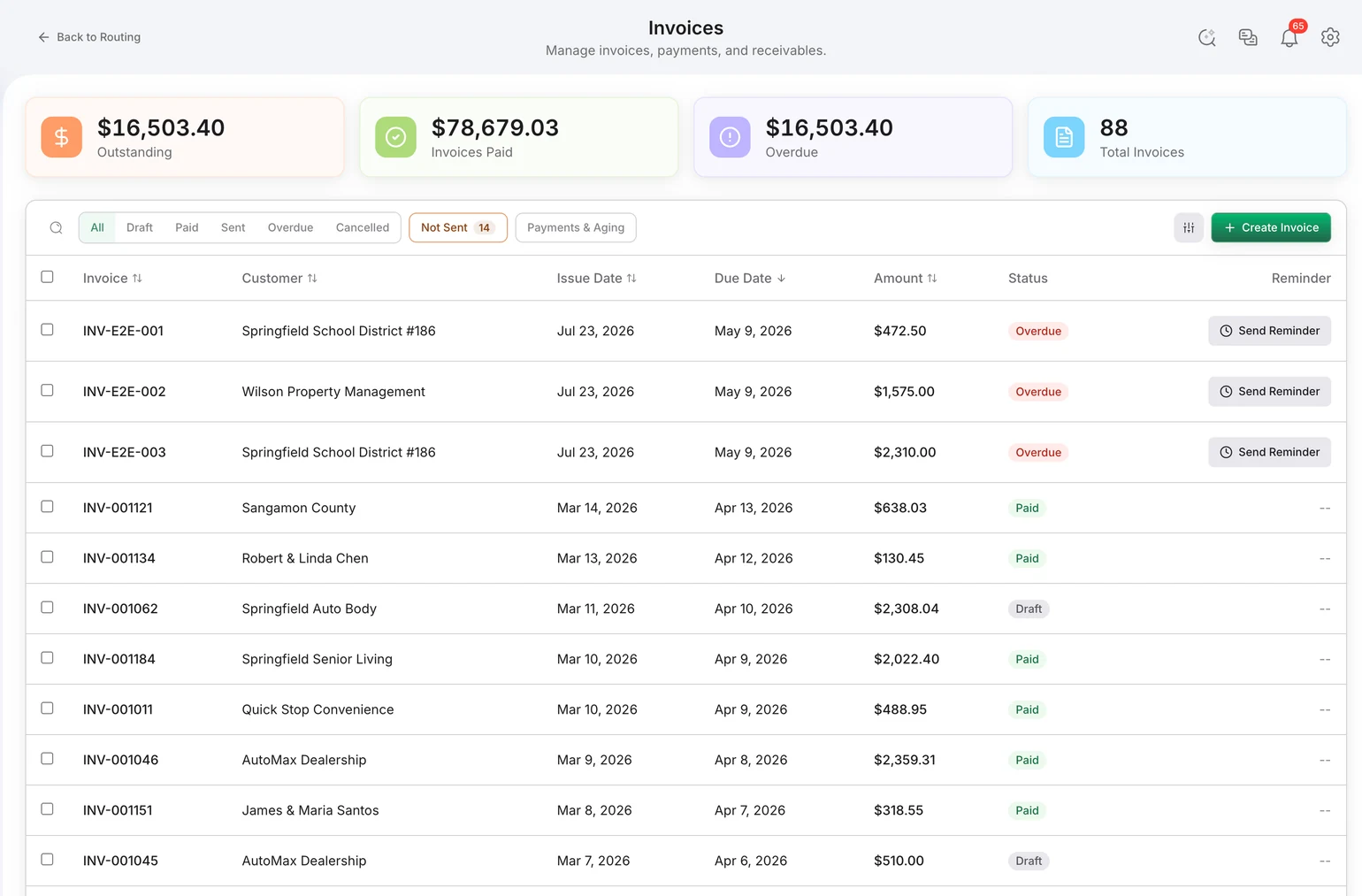
What does Bond4Waste do well for an electrical service department? The service half of the business maps directly. Live GPS dispatch with traffic-aware rerouting and automatic notification to the field, recurring service schedules and service zones for maintenance contracts, route sequencing for a day of small jobs, an offline-first mobile app with photos, notes, and signature capture, expense and document capture at the job, invoice generation with a billing approval step, a customer payment portal with card, ACH, and check, automatic overdue follow-up, two-way QuickBooks Online sync, and role-based access with a complete audit log.
Is Bond4Waste built for electrical contractors? No. Bond4Waste is route-based service operations software whose production deployments today are waste and recycling haulers and municipal collection programs. This page exists because the service and recurring-maintenance half of an electrical business runs the same four-part loop of plan, dispatch, prove, and bill that the platform is built for. The project half does not, and that is stated here rather than glossed over.