A lawn maintenance company does not lose money on the properties it services — it loses money between them. Crews are paid for a full day, revenue only accrues while they are on a property, and every extra minute of drive time is labor and fuel with nothing to invoice against. That is why landscaping software is a routing problem before it is a scheduling problem, and why the tools built around appointment booking rarely fit.
What is landscaping route software?
Landscaping route software plans recurring property visits into sequenced crew days, sends those days to a mobile app, captures photo proof that each property was serviced, and connects completed visits to billing. The distinguishing behavior is that it treats travel between properties as a cost to minimize, not as empty space between appointments.
Recurring maintenance is the purest form of route-based service work: the same addresses, on a fixed cycle, with the whole business model resting on how many of them a crew can clear before the day runs out.
Why route density decides the margin
In recurring maintenance, drive time is the only cost you can cut without cutting quality. The arithmetic is unforgiving and easy to check against your own numbers:
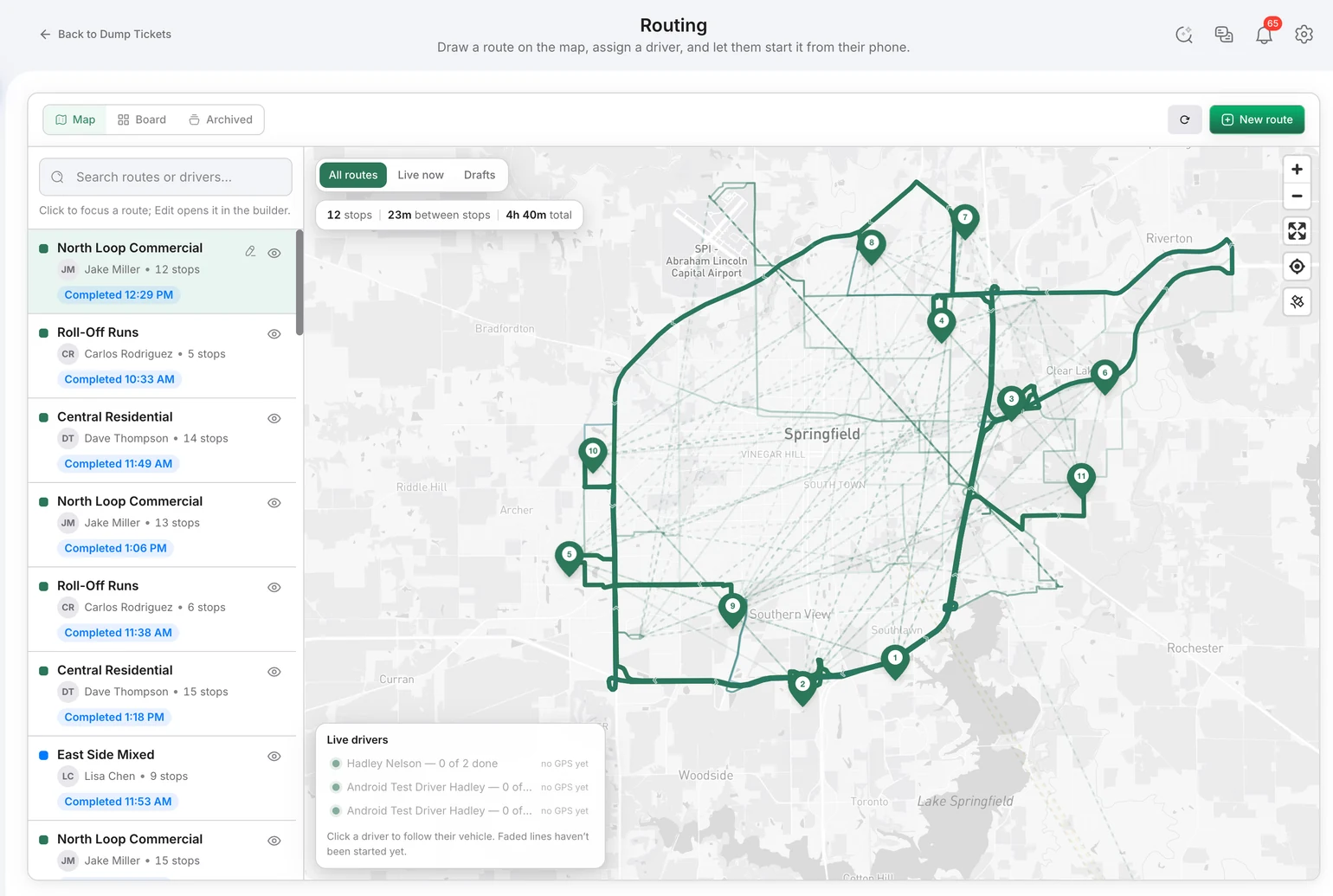
Two capabilities move that number. Service zones keep new customers inside the geography a crew already covers instead of scattering them across a metro. Route sequencing orders the day so the crew is not crossing its own path. Bond4Waste includes service zone management and route planning and optimization, which are the two levers that matter here, and the sequenced day is what the field user sees in the mobile app.
Crews are not solo drivers, and software usually assumes they are
Most field service software models one person per unit of work; maintenance landscaping sends two to four people in one truck. That mismatch shows up in three places, and it is worth being precise about which of them you actually need to solve.
- Assignment. The day is assigned to a truck and its crew, and one person — the crew lead — carries the device and closes out each property. This works cleanly in a route-based model, where the unit of assignment is a day of stops rather than a person-appointment.
- Time capture. If you need labor hours per crew member per property rather than crew-day totals, that is a distinct requirement. In Bond4Waste the mobile app is used by an individual field user, whose platform role is called driver. Per-member time capture across a crew is an open question to raise in a demo.
- Accountability. Every completion, photo, and note is written to the job record and to the platform’s audit log, so a visit can be reconstructed later without depending on anyone’s memory.
Seasonal contracts, uneven visits, and the billing mismatch
The defining financial quirk of landscape maintenance is that the money is level and the work is not. A residential contract might bill the same amount in April and August while the visit count, crew hours, and material cost differ substantially between them. Commercial contracts add a second layer: a scope with a required frequency, plus approved extra work that has to be billed separately without polluting the base contract.
| Billing pattern | What the system must reconcile | Bond4Waste today |
|---|---|---|
| Per-visit invoicing | Each completed visit produces its own charge. | Documented. A completed job generates an invoice with line items, taxes, and totals for review. |
| Extra work at the property | Approved enhancements billed on top of the contract, with proof they were requested. | Documented. Additional work orders and job records with photos and notes. |
| Level monthly contract installments | A flat charge each month while visit frequency swings by season. | Not documented. Verify contract-installment billing directly before you buy. |
| Collection and follow-up | Getting paid without a monthly chase list. | Documented. Customer portal payment by card, ACH, or check, with automatic overdue follow-up. |
Per-visit proof is the cheapest insurance in the trade
The recurring dispute in lawn maintenance is not quality — it is attendance. A property manager says the crew skipped a week. Without a field record, the argument is your memory against theirs, and the credit gets issued because arguing costs more than the visit was worth.
The fix is to make proof a byproduct of closing the stop. Bond4Waste captures completion time, location, and photos on the job record from the mobile app, and the app is built offline-first, so a crew working through a coverage dead zone can still close out the property and sync when service returns. That same field-report mechanism — a photo plus a short written description sent from the app to the office and surfaced to the customer — exists in the platform today under waste-industry naming as contamination reporting; the structure is what a property condition note needs, though the label is not a landscaping label.
Three field records are worth capturing on every visit:
- Arrival and completion, with timestamp and location, which settles the attendance question outright.
- A condition photo, which settles the quality question and doubles as an upsell record when something at the property needs work.
- An exception note, for the locked gate, the parked car, the dog in the yard — the reasons a visit was partial, recorded before anyone has to explain them.
The route changes shape three times a year
A landscape maintenance route is not one schedule — it is a sequence of different operations run over the same customer list. Software that can only hold one visit template per customer forces a rebuild every time the season turns.
| Season | What changes operationally | What the record has to carry |
|---|---|---|
| Spring cleanup | Longer time on each property, fewer stops per day, heavy debris volume. | Revised day capacity and any disposal cost created by the visit. |
| Mow season | High-frequency, short-duration, density-critical work on a fixed cycle. | Cycle adherence and per-visit proof at every property. |
| Fall cleanup | Multiple passes at the same property, weather-driven rescheduling, large debris loads. | Which pass this was, and what it cost to dispose of what was collected. |
Note the thread running through all three: the debris has to go somewhere, and the tipping fee is a cost incurred at a facility that has to find its way back to the right customer or job. That is the same problem Bond4Waste solves for haulers with photographed field document capture — a crew photographs the scale ticket, the platform extracts reviewable fields, and the source image stays attached to the work that produced it.
How to evaluate landscaping software: the one-route, one-season test
Do not evaluate on a single property. Evaluate on one full crew day, then fast-forward it through a season change.
- Load twenty real properties, sequence them, and compare the result to how your best crew lead would order the day.
- Add a customer four towns away and watch what the system does to the route and to your service zones.
- Skip a property for rain, then show me how it gets made up and who is told.
- Close out a stop with photos on a phone in airplane mode, then reconnect and confirm what synced.
- Sell an enhancement at the property and follow it to a separate line the customer can see and pay.
- Run the debris cost from the disposal facility back to the job that created it.
- Switch the same customer list from weekly mowing to fall cleanup and count how much rebuilding that took.
For the general model, see AI software for route-based service businesses. For dispatch mechanics in depth, see routing and dispatch software.
Frequently asked questions
What is landscaping route software? Landscaping route software plans recurring property visits into sequenced crew days, dispatches those days to a mobile app, captures photo proof that each property was serviced, and connects the completed visits to billing. It differs from generic scheduling software because it treats drive time between properties as a cost to be minimized rather than as dead space between appointments.
Why does route density matter so much in lawn care? Because a maintenance crew is paid for the whole day but only earns revenue while it is on a property. Every minute of drive time between stops is labor and fuel with no invoice attached. In a business where individual visits are small and repeat weekly, the number of properties a crew clears in a day is the primary lever on gross margin, which makes sequencing and service-zone design an operational decision rather than an administrative one.
How do you prove a lawn care visit actually happened? With a field record captured at the property: an arrival and completion timestamp, GPS location, and photos taken by the crew. Route-based service software makes that capture part of closing the stop rather than an optional extra. In Bond4Waste, the mobile app records completion, location, and photos on the job record, and it is built offline-first so a crew in a dead zone can still close out the property and sync later.
Can Bond4Waste bill an annual landscaping contract in monthly installments? That is not a documented Bond4Waste capability today and should be verified directly. What is documented is that a completed job generates an invoice with line items, taxes, and totals for a billing reviewer to approve, that payments are tracked, and that customers pay through a portal by credit card, ACH, or check. A company whose contracts bill on a flat monthly installment while visit frequency varies by season should make contract-installment billing an explicit demo requirement.
Does the mobile app work for a crew rather than a single person? The Bond4Waste mobile app is used by an individual field user, and the platform role for that user is called driver. In practice a crew lead carries the day and closes out each property. If your requirement is per-crew-member time capture across a multi-person crew, treat that as an open question for a demo rather than an assumed capability.
Is Bond4Waste built for landscaping companies? Bond4Waste is route-based service operations software, and its production deployments today are waste and recycling haulers and municipal collection programs rather than landscape maintenance companies. The workflows recurring lawn maintenance depends on are present: recurring scheduling, service zone management, route planning and optimization, live GPS dispatch, an offline-capable mobile app with photo capture, automated invoice generation with human approval, and a customer payment portal. Landscape-specific objects such as a plant or bed inventory and chemical application records are not documented capabilities.