Every route-based service business runs the same four-part loop: plan the day, dispatch it, prove the work happened, and bill it. A waste hauler, an HVAC maintenance department, a lawn care company, a plumbing shop, and an electrical service board all break at the same joints when those four steps live in different systems. This page explains the model, the vocabulary each trade uses for the same objects, and the questions to ask any vendor selling into it.
What is route-based service software?
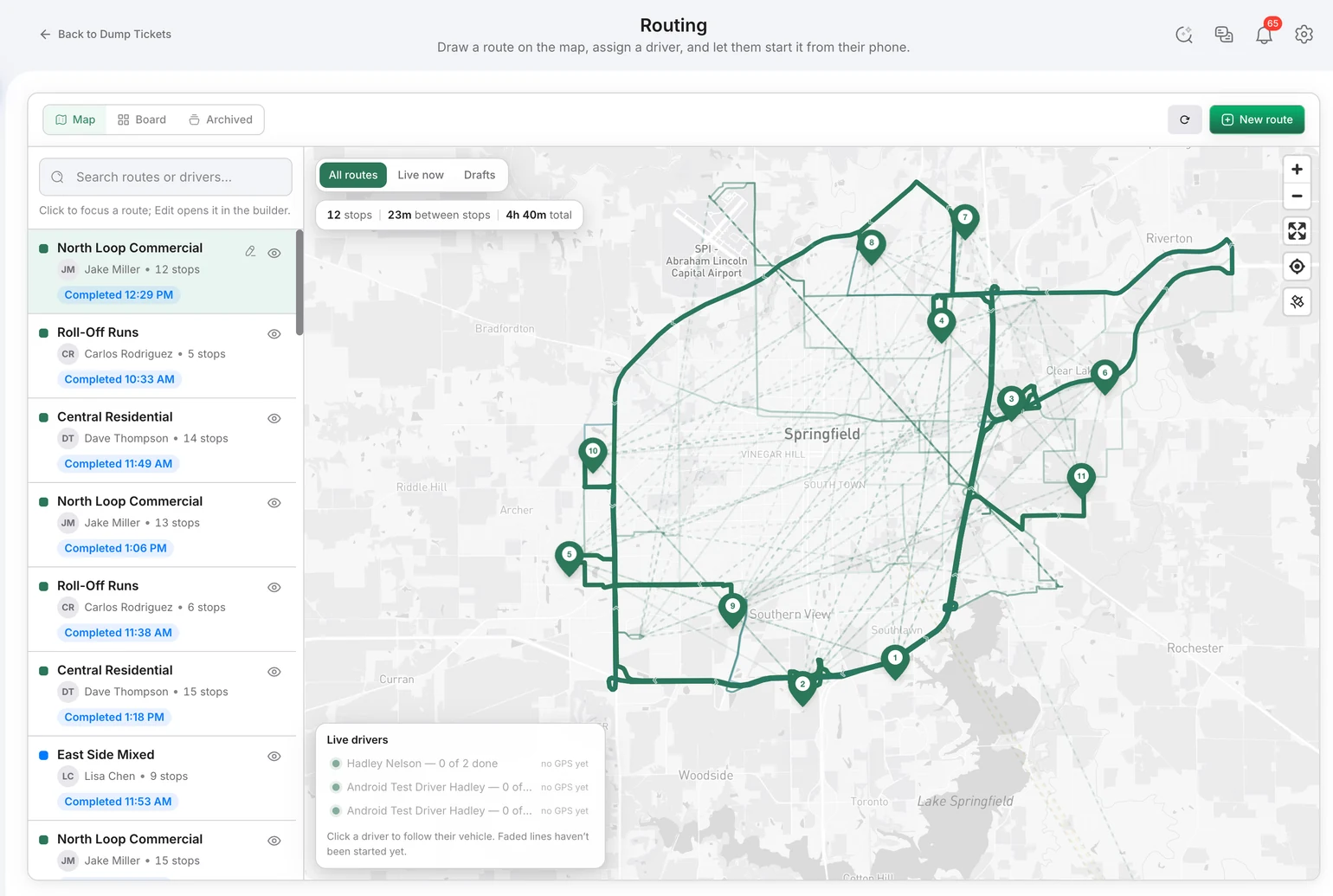
Route-based service software is an operating system for businesses that send people to a repeating list of customer addresses. It builds the day of stops, dispatches them to a mobile app, captures proof that each stop was served, records the costs incurred at the stop, and turns that record into an invoice without anyone retyping it.
The category is defined by what it connects, not by any single feature. Scheduling tools plan work but do not carry it into billing. Accounting systems bill work but never saw it happen. GPS trackers show where a truck went but not what it did at the address. Route-based service software exists because the handoffs between those three are where operations lose money: the missed stop nobody logged, the disposal fee nobody billed, the dispute nobody can answer.
What makes a business “route-based”?
A service business is route-based when travel between customer addresses is a scheduled, repeating cost of doing the work. Six characteristics tend to travel together:
- The work happens at the customer’s address, not at your facility.
- The same addresses repeat on a schedule — weekly, monthly, quarterly, or seasonally.
- Sequence matters, because drive time between stops is unbilled labor and fuel.
- The person in the field is the only witness, so proof has to be captured there or it does not exist.
- Costs are incurred at the stop — a disposal fee, a part, a bag of material — and have to find their way to the right job.
- Revenue is recognized per visit or per contract period, which means the visit record and the invoice have to agree.
A business that matches four of those six is route-based even when its trade association calls it something else. That is why the same software problem shows up in waste hauling, lawn maintenance, HVAC preventive maintenance, commercial plumbing service, and scheduled electrical maintenance.
The four-part loop, and what breaks without connected software
Each stage of the loop fails in a predictable and expensive way when it is disconnected from the next one.
| Stage | What has to happen | How it fails when disconnected |
|---|---|---|
| 1. Plan | Turn recurring schedules and new requests into an ordered day per vehicle or crew, inside defined service zones. | Sequence is built from memory. New work is squeezed in without knowing the day’s remaining capacity. |
| 2. Dispatch | Push assigned work to the field, watch progress live, and reassign when the day changes. | Changes move by phone call and text. The office and the field hold two different versions of the day. |
| 3. Prove | Capture completion time, location, photos, signatures, exceptions, and any document created at the stop. | Proof lives in a camera roll and a memory. A disputed visit costs more in office time than the visit earned. |
| 4. Bill | Convert completed work and its costs into a reviewed invoice, notify the customer, and collect. | The day is re-keyed from paperwork. Pass-through costs are missed and invoices go out late or short. |
In Bond4Waste, completing a job in the driver app generates an invoice with line items, taxes, and totals for a billing reviewer to approve. The customer is notified by email and can pay by card, ACH, or check through the customer portal, and overdue invoices trigger automatic follow-up. The point is not any individual feature — it is that stage four reads from stage three instead of from a stack of paper.
Every route trade uses different words for the same five objects
The vocabulary changes by trade; the data model does not. This is the most useful thing to hold in your head when comparing software across trades, and the fastest way to tell whether a vendor built a real operating record or a trade-specific form.
| Object | Waste & recycling | HVAC | Landscaping | Plumbing | Electrical |
|---|---|---|---|---|---|
| The day’s plan | Route | Service board plus PM schedule | Crew route | Dispatch board | Service board plus project schedule |
| A unit of work | Stop or work order | Service call or PM visit | Property visit | Service call | Service call or job day |
| The thing at the address | Container | Installed unit and its serial | The property and its beds | Fixture, line, or backflow device | Panel, circuit, or fixture set |
| Proof it happened | Photo, timestamp, signature | Readings, technician notes, photos | Before and after photos | Photos, parts used, signature | Photos, sign-off, test results |
| The cost event at the stop | Dump or scale ticket | Part or refrigerant used | Material or product applied | Part pulled from the truck | Material and gear consumed |
| The billing basis | Per lift plus disposal | Flat rate, time and materials, or agreement | Per visit or contract installment | Flat rate or time and materials | Time and materials or contract draw |
Bond4Waste models these objects with waste-industry names today: containers, dump tickets, and scale-house records are first-class. That is an honest constraint to raise in a demo if you run a different trade. The loop is the same, but ask to see how your object at the address and your cost event at the stop are represented before you buy.
How does AI change route-based operations?
AI earns its place in route operations wherever a person is currently retyping something or asking someone else for a number. In Bond4Waste that is three specific jobs:
- Field document capture. A driver photographs a scale or dump ticket and the platform extracts reviewable fields such as weight, material, facility, and fees, keeping the source image attached to the job. See how document capture works →
- Questions over live operational data. The built-in Intelligence Module answers natural-language questions against the operation’s own records — top customers by revenue, jobs completed per driver, revenue this month versus last — without an export to a spreadsheet.
- Planning and re-planning the day. Route planning and optimization sequence the stops, and dispatch can see traffic, accidents, and road blocks on the live map and reroute a driver, who is notified automatically instead of by phone.
Which route-based trades does this apply to?
The loop generalizes; the fit does not, and the differences are worth reading before you assume your trade is covered. Each page below is written for one trade and is explicit about what maps directly to Bond4Waste today and what does not.
HVAC service and maintenance
Maintenance agreements are recurring route work; repair calls are an unscheduled queue. One board has to hold both through a heat wave.
Landscaping and lawn care
Margin is stop density and drive time. Crews repeat the same properties weekly, and every visit needs proof it happened.
Plumbing service and dispatch
Emergency calls are routing decisions with a clock attached: who is closest, who is qualified, and what did we do at this building last time.
Electrical contracting
A service board behaves like a route. A multi-day project does not. Knowing which half of the business route software fits is the whole decision.
Waste, recycling, and municipal collection
The operation Bond4Waste runs in production today: residential, commercial, roll-off, C&D, recycling, brokerage, and municipal collection.
Adjacent route-based services
These trades sit closest to waste hauling because a disposal or treatment event is part of nearly every stop:
- Pest control — Recurring treatment visits on a fixed cycle, with a service record per visit.
- Portable sanitation and septic pumping — Route service plus a disposal event at a facility on nearly every stop.
- Junk removal — Variable job duration and a disposal cost that decides whether the job was profitable.
- Street sweeping — Municipal contract routes measured in coverage and documented for the contract holder.
What to verify before buying route-based service software
Run one real day through every vendor you shortlist, then break it halfway through. A demo that only shows the happy path tells you nothing about a category whose entire value is exception handling.
- Rebuild your densest day. Can you reorder stops, split a route between two vehicles, and see the effect on the rest of the schedule?
- Break the day at 10 a.m. Add an emergency call, take a vehicle out of service, and reassign work already in progress. Watch whether the field sees it without a phone call.
- Put the field app on a phone and turn off the network. Complete a stop, take photos, capture a signature, then restore service and confirm exactly what synced.
- Create the cost at the stop. Capture whatever document or consumable your trade generates and follow it all the way to a line on an invoice.
- Bill both ways. Invoice a one-off visit and a contract period, then look at what the customer actually receives and how they pay it.
- Check the role model. Confirm which roles exist, what each one can see, and whether every change is written to an audit log.
- Get migration in writing. Define which customers, sites, assets, schedules, prices, balances, and history move — and who does the work.
For a worked example of this evaluation applied to a single trade, see the 2026 waste management software buyer’s guide, which compares seven named platforms against a route-to-invoice workflow.
Where Bond4Waste fits
Bond4Waste is a cloud platform with a native B4W Driver app for iOS and Android, built so that the route record, the field record, the cost record, and the billing record are the same record. The production deployment today is waste and recycling: residential, commercial, roll-off, C&D, recycling, brokerage, and municipal collection. The platform includes customer management, container and equipment tracking, route planning and optimization, live dispatch with GPS, work order management, scheduling, billing and invoicing, payment tracking, a sales CRM, fleet management, scale-house ticketing, compliance and reporting, service zone management, and a complete audit log, alongside a customer billing portal.
Plans start at $50/month and scale with workflows, users, locations, and capabilities. Start with the workflow you want to fix: routing and dispatch, field document capture, or the complete operations platform.
Frequently asked questions
What is route-based service software? Route-based service software is an operating system for businesses that send people to a repeating list of customer addresses. It builds the day of stops, dispatches them to a mobile app, captures proof that each stop was served, records the costs incurred at the stop, and turns that record into an invoice without anyone retyping it. The defining feature is that planning, field work, cost capture, and billing share one record instead of four systems.
What is the difference between route-based service software and field service management software? Field service management software is usually organized around an appointment: a technician, a time window, and a customer. Route-based service software is organized around a sequence: a vehicle, a day, and an ordered list of addresses where travel time between stops is itself a cost. Most trades need both models. HVAC, plumbing, and electrical service run an appointment book alongside recurring maintenance routes, while waste collection and lawn care are almost entirely sequence-driven.
Does Bond4Waste work for HVAC, landscaping, plumbing, or electrical companies? Bond4Waste is built for route-based service operations and runs in production today for waste and recycling haulers and municipal collection programs. The workflows those trades share with other route-based businesses already exist in the platform: recurring service schedules, live dispatch with GPS, a native offline mobile app, photo and signature proof, cost capture at the job, automated invoice generation with human approval, and a customer payment portal. Some objects and labels still use waste-industry vocabulary, such as containers rather than installed equipment. The honest evaluation for a non-waste trade is a live demo against a real workflow, where Bond4Waste Inc. can show which parts map directly and which do not.
What does AI actually do in route-based operations software? In Bond4Waste, AI does three specific jobs. It reads photographed field documents such as scale and dump tickets and turns them into structured, reviewable fields. It answers natural-language questions over live operational data through the built-in Intelligence Module, including revenue, customer, and job-completion questions. And it supports route planning and optimization so dispatch can sequence a day rather than order it by hand. AI does not approve invoices or assign work on its own: extracted documents keep their source image for review, and generated invoices go to a person before they reach a customer.
Can one platform run more than one route-based trade? It can when the trades share the same four-part loop of plan, dispatch, prove, and bill. The practical test is whether the platform can hold the trade-specific object at the address, the trade-specific cost event at the stop, and the trade-specific billing basis. A platform that models only one of those three will force the second trade into workarounds.
How is route-based service software priced? Pricing in this category is usually per user or per vehicle per month, often with a one-time implementation fee covering data migration, configuration, and training. Bond4Waste plans start at $50/month and scale with the workflows, users, locations, and capabilities an operation needs, with a one-time implementation fee quoted up front and monthly or annual terms rather than multi-year lock-ins.