How do you prove service on a municipal sweeping contract?
You prove it with a per-shift record that ties date, location, vehicle, operator, and condition together, produced as the work happens rather than reconstructed at month end. A sweeping contract is unusual among service contracts because the customer cannot inspect the deliverable after the fact — by the time anyone looks, traffic and weather have already changed the street. The record is the only surviving evidence that the pass occurred.
That is why sweeping disputes so rarely turn on quality and so often turn on documentation. A contract administrator asking “was Elm Street done on the 12th” is not questioning the crew; they are being asked the same question by someone else and need something to hand over.
What a proof-of-service package has to contain
| What the contract needs shown | The record that supports it |
|---|---|
| Service occurred on the scheduled date | Completion timestamp recorded when the operator closes the work in the driver app |
| Service occurred in the right place | GPS location captured with the completion, plus live vehicle tracking during the shift |
| The right operator and vehicle performed it | Assignment on the route, under role-based access control with a full audit log |
| Conditions before and after | Photos attached in the mobile workflow at the stop |
| Exceptions and what blocked them | Notes and photos on the stop; parked vehicles, construction, and weather holds are the usual causes |
| Where the debris went | The disposal ticket photographed at the facility, with weight, material, facility, and fees extracted |
| Who changed what, and when | Complete audit log across the platform |
The deliverable is the report, not just the sweep
On a municipal contract, reporting is not overhead — it is half the scope of work. The operational failure mode is a fleet that swept everything it was supposed to sweep and cannot show it, because the evidence is spread across a paper log in the sweeper, a text thread with the supervisor, and a stack of scale tickets in the yard office.
Bond4Waste keeps that evidence in one operating record as a by-product of running the route: the operator works the assigned route in the driver app, completion is captured with timestamp and GPS, photos and exception notes attach at the stop, and every change is written to a complete audit log. Reporting draws from the same record the operation ran on.
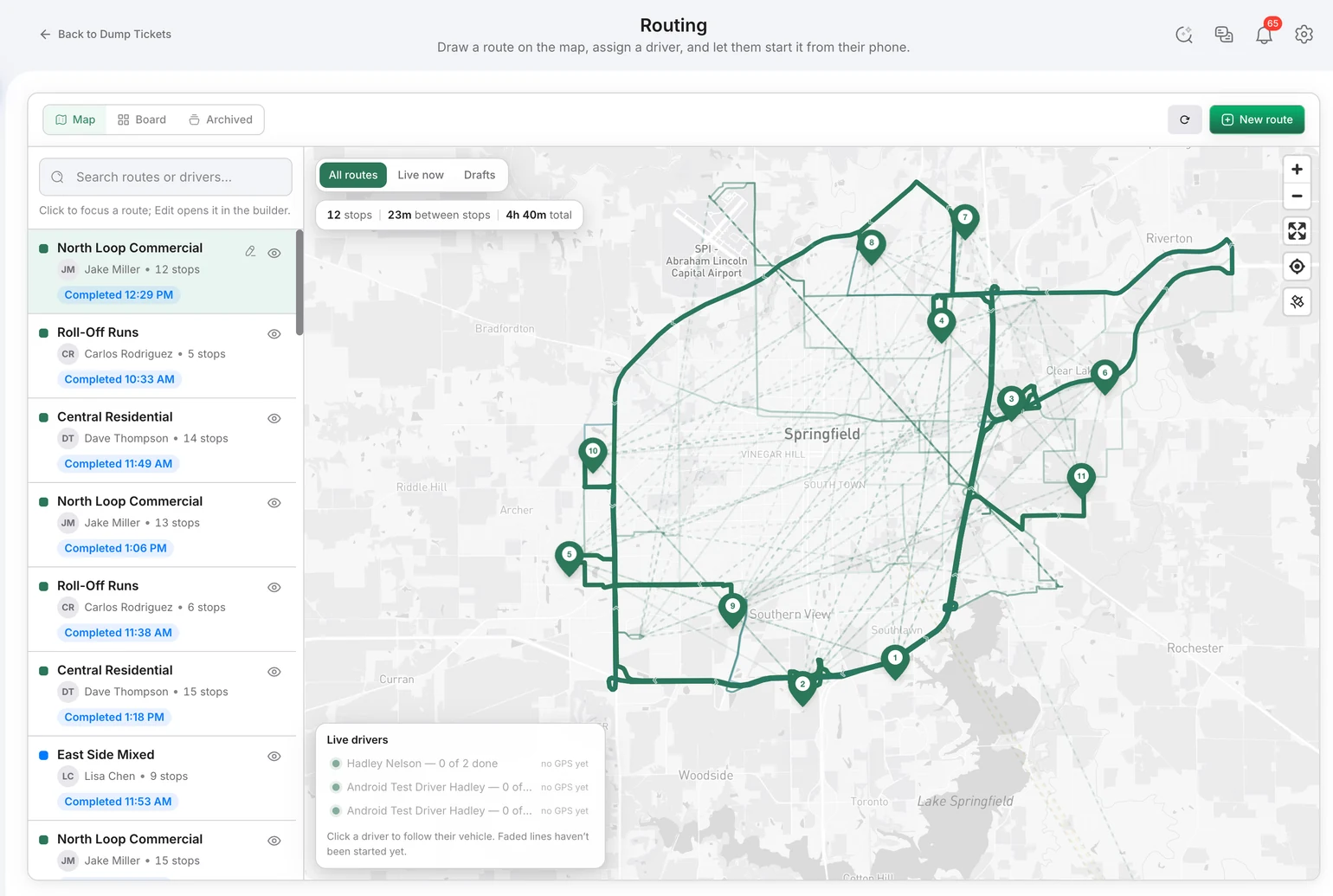
Sweeping routes are geography, not customers
The unit of work in sweeping is a piece of the map, not an account. That inverts the usual assumptions of service software: there is no subscriber to notify, no container to track, and often no signature to collect. What there is instead is a recurring obligation attached to a zone, a posted schedule the public may be relying on, and parking restrictions that make the timing non-negotiable.
Bond4Waste handles this through scheduled routes and service zone management, with dispatch able to reassign work live when a sweeper goes down or a zone has to be deferred. Where a residential collection route would carry customers, a sweeping route carries the segments and zones you have committed to.
Debris has to be dumped, and the ticket is the cost record
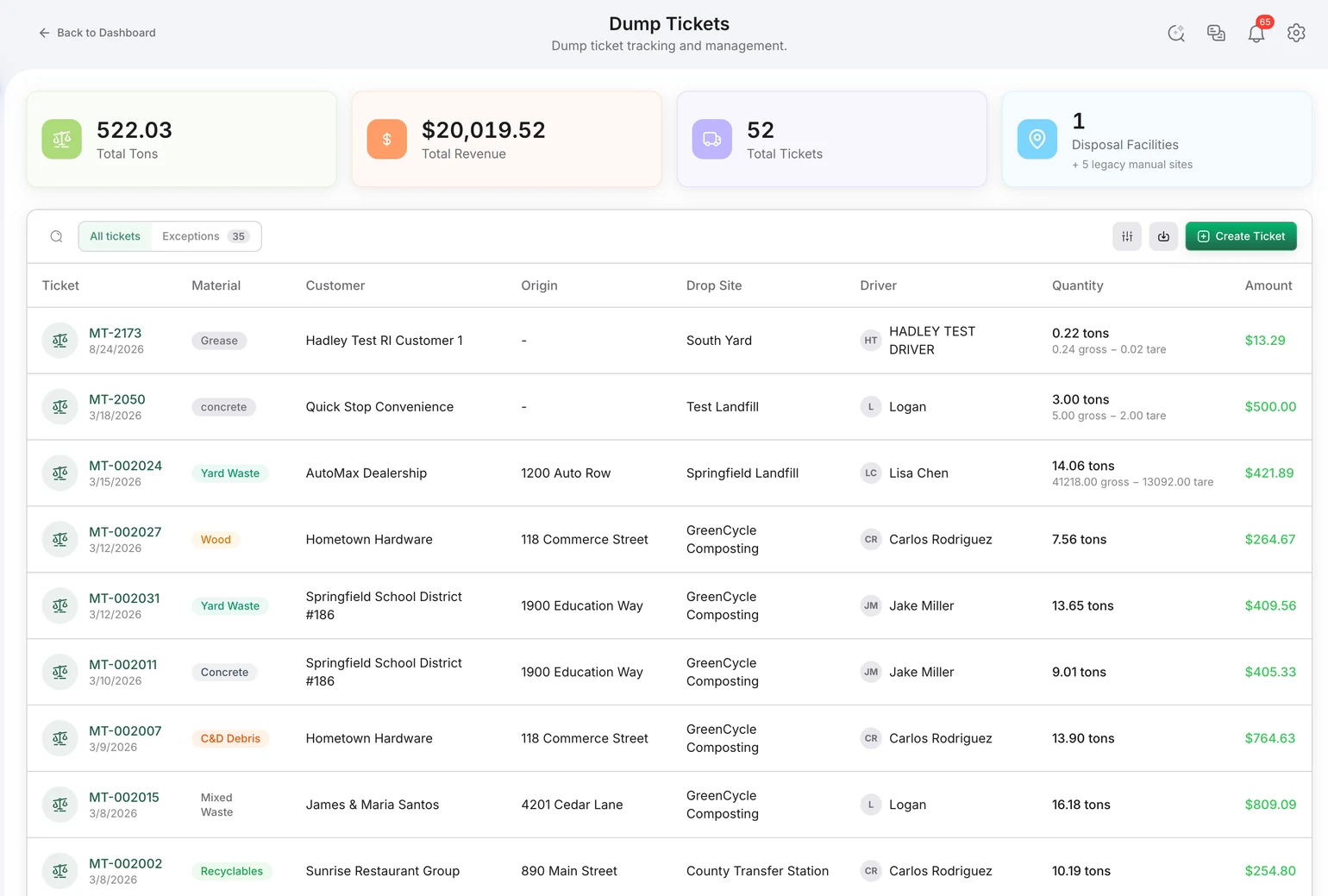
Every sweeping shift ends with a load that has to be disposed of, and that ticket is the only reliable record of the shift’s disposal cost. This is the part of sweeping that is genuinely identical to waste hauling, and it is the part most sweeping operations handle worst — tickets ride in the cab for a week and get retyped by someone guessing which route they belonged to.
Bond4Waste captures the ticket at the facility: the operator photographs it and OCR extracts weight, material, facility, and fee fields, with the original image retained for review. The ticket stays attached to the route that produced it. The full workflow is on the dump ticket OCR page.
Two buyers, one workflow
| Contractor on a municipal contract | In-house public works fleet | |
|---|---|---|
| Who reads the report | The contract administrator, on a schedule written into the agreement | The department head, council, and residents who filed a request |
| What proof is for | Getting the invoice approved and defending the renewal | Answering complaints and justifying budget and headcount |
| Billing | Invoices generated from completed work, reviewed before they go out | Often unused, or used for interdepartmental cost recovery |
| Biggest operational risk | Unprovable service on a disputed month | No defensible answer when a resident escalates to a council member |
What to confirm before you bid a contract on this software
- Curb-mile measurement. If the contract pays by curb mile, ask exactly how the number is produced and whether GPS breadcrumb is converted to segment-level as-swept coverage.
- Report format. Bring the actual report your contract requires and ask how it is produced and exported.
- Posted-schedule constraints. Confirm how street-cleaning parking restrictions and fixed public schedules are represented in the route.
- Retention. Confirm how long records, photos, and tickets are retained relative to what the contract requires.
Related route operations
The closest neighbour is snow removal dispatch software, which shares the municipal contract shape and inverts the scheduling model. The underlying layers are covered in routing and dispatch and the complete platform, and the category across trades in route-based service software.
Frequently asked questions
How do you prove service on a municipal street sweeping contract? You prove it with a per-shift record that ties date, location, vehicle, operator, and condition together. In practice that means a timestamped completion with a GPS location for each routed segment or zone, photos where conditions are disputed, notes explaining anything skipped, and the disposal ticket showing where the sweepings went. Bond4Waste captures each of those as part of the normal route workflow rather than as a separate reporting exercise at month end.
What is street sweeping software? Street sweeping software is route operations software adapted to a service whose customer is a contract rather than a subscriber. It schedules recurring sweeping work by zone or route, assigns it to operators and sweepers, tracks vehicles live during the shift, records completion with proof, captures the disposal ticket for the debris load, and produces the record the contract administrator expects to see.
Can a public works department use this directly instead of a contractor? Yes. Municipal operations are among the audiences Bond4Waste is built for, alongside residential, commercial, roll-off, C&D, recycling, and brokerage waste operations. An in-house public works fleet uses the same scheduling, dispatch, mobile capture, and reporting workflow as a contractor; the difference is that the reporting audience is internal and the billing workflow may be unused or used for interdepartmental cost recovery.
How are debris disposal loads recorded? Sweeper debris is disposed of at a facility that issues a ticket, and that ticket is the cost record for the load. In Bond4Waste the operator photographs it in the mobile workflow and OCR extracts weight, material, facility, and fee fields, keeping the original image alongside the extracted values. The ticket stays attached to the route that produced it rather than accumulating in a folder for the office to reconcile later.
Does Bond4Waste track curb miles swept per segment? The platform tracks vehicles with real-time GPS and records completion against routed work and service zones. It does not advertise a segment-level as-swept mapping product that converts GPS breadcrumb into certified curb-mile totals per street segment. If your contract is measured and paid in curb miles, treat that as the first question in a demo rather than an assumption.