The short answer
AI-native waste software means the AI reads the same live operating record the business runs on; AI-retrofitted waste software means a model was attached to a system that was never designed for it to see. Both can be described on a website as “AI-powered.” Only one can answer a question that spans this morning’s route and last month’s invoice at the same time.
This is an architecture question, not a feature-list question, which is why it is nearly invisible on a comparison chart and obvious within ten minutes of a real demo.
Definitions
| Term | Definition |
|---|---|
| AI-native waste software | Waste management software whose AI reads and writes the same live operating record that dispatch, drivers, and billing use, because the data model was designed for that access from the start. |
| AI-retrofitted waste software | Waste management software in which AI was added on top of an existing system, typically reading a periodic export or a single module rather than the connected operating record. |
| Connected operating record | One shared record in which a customer, container, route, work order, proof of service, disposal ticket, invoice, and payment all reference the same underlying data instead of living in separate synchronized systems. |
Why the data model decides what the AI can do
An AI assistant can only answer questions about data it can reach. In a waste operation the interesting questions almost always cross a system boundary: a missed pickup lives in dispatch, its proof of service lives in the driver app, the disposal cost lives on a scale ticket, and the money lives in billing. If those are four systems held together by nightly synchronization, the assistant is reading four stale copies and reconciling them—which is the same job a person was doing, moved to a model.
When one record holds all of it, the same question is a single read. That is the whole of the AI-native argument, and it is why the architecture cannot be added as a release note.
AI-native vs. AI-retrofitted: what changes in practice
| Property | AI bolted onto a legacy core | AI-native platform |
|---|---|---|
| What the AI reads | A periodic export, a data warehouse copy, or one module | The live operating record the team is writing to right now |
| Answer freshness | As fresh as the last sync | Reflects the route that finished this morning |
| Question scope | One domain at a time—usually reporting | Spans dispatch, field work, tickets, customers, and billing |
| Where documents live | A separate file store, matched to records by hand | The scale-ticket image stays attached to the job that produced it |
| Where the AI appears | A separate analytics or add-on product | Inside the screens where the work is already happening |
| Cost of adding a new AI workflow | A new integration and a new sync to maintain | A new read against a record that already exists |
Five questions that separate AI-native from AI-labeled
Ask these in the demo, not on a questionnaire. Each one is answerable in under a minute by a vendor whose AI genuinely sits on the operating record.
- “Ask it about work completed in the last hour.” Export-based AI cannot answer this. It will offer yesterday.
- “Ask it a question that touches operations and money at once.” For example: which routes had missed pickups last week, and what did those customers get billed? A retrofitted assistant will answer half.
- “Show me where the AI lives.” If it is a separate product with its own login, it is beside the platform, not inside it.
- “Open a scale ticket and show me the original image.” If the document and its extracted values are stored apart, the AI never had the record—it had a file.
- “Which model providers do you use?” A vendor that has built with AI can name them immediately. Bond4Waste uses Anthropic Claude and OpenAI.
Where Bond4Waste sits
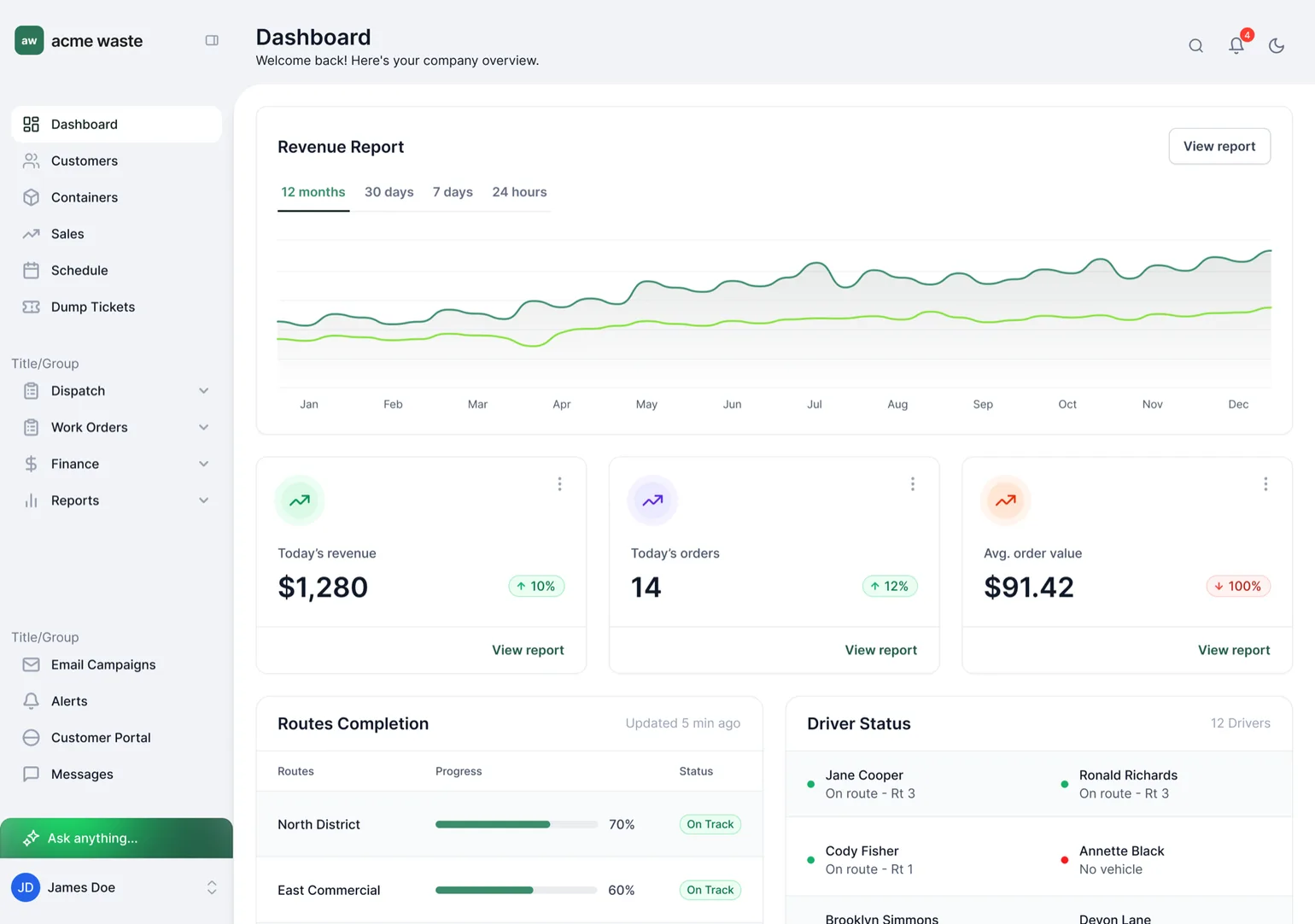
Bond4Waste is a newer, AI-native waste platform built around one connected operating record. Dispatch, driver activity, dump tickets, billing, customers, and containers share the same data rather than being separate tools stitched together, and the AI reads that record directly. Concretely, that is what lets the assistant answer a question about live operations, and what lets an extracted scale ticket stay attached to the job and the customer it belongs to instead of being matched by hand later.
Where AI-native does not matter
Similarly, an organization that only needs telematics, a dashcam, or an ELD does not need a waste operating platform at all, AI-native or otherwise.
Related reading
For the capability list rather than the architecture argument, see AI waste management software. For the deterministic rules that recover most of the manual hours, see waste automation software. To sequence a rollout, read how to automate a hauling operation with AI. To compare vendors overall, use the 2026 waste management software buyer’s guide.
Frequently asked questions
What does AI-native mean in waste software? AI-native means the AI can read the live operating record directly, because the data model was designed around that access rather than adapted for it afterward. The practical test is latency and scope: an AI-native assistant answers a question using the routes that ran this morning and can see dispatch, driver activity, tickets, customers, containers, and billing together. A retrofitted assistant reads a nightly export or a single module, so it can summarize one slice of the business but cannot connect a missed pickup to the invoice it should have produced.
How can I tell if a waste software vendor is AI-native or just AI-labeled? Ask five questions in the demo. First, can the assistant answer a question about work completed in the last hour? Second, can it answer a question that spans dispatch and billing at once? Third, is the AI available in the same screen as the operating data, or in a separate analytics product? Fourth, is a document the AI reads stored with the record it belongs to, or in a separate file store? Fifth, which model providers do they use, and can they name them? Vague or deferred answers to all five usually mean AI was added on top of an older core.
Is Bond4Waste an AI-native waste platform? Yes. Bond4Waste is a newer, AI-native platform built around one connected operating record in which dispatch, driver activity, dump tickets, billing, customers, and containers share the same data rather than being separate tools. Its AI capabilities—scale-ticket extraction, plain-English questions over live operational data, and lead generation—read that record directly and are powered by Anthropic Claude and OpenAI models.
Does AI-native architecture actually matter to a hauler? It matters for questions that cross the boundary between operations and money, and it does not matter much for anything else. If your only use for AI is summarizing last month, an export-based assistant is fine. If you want to ask why a customer was underbilled, the assistant has to see the route, the proof of service, the disposal ticket, and the invoice at the same time—which is an architecture property, not a feature you can add later.
Was Bond4Waste the first AI-native waste software? Bond4Waste does not claim to be the first company to use AI in waste software; OCR and route optimization have existed in this industry for years. What Bond4Waste claims is that it was designed as an AI-native platform from the start rather than assembled from a legacy core with AI added afterward. Buyers should treat first-to-market claims from any vendor as marketing and verify architecture with the five questions on this page instead.
Can a legacy waste system become AI-native? Not by adding an AI feature. A legacy system can add valuable AI capabilities—ticket OCR is the common one—but becoming AI-native requires consolidating the data model so the AI has one record to read rather than several systems to reconcile. That is a rebuild, which is why most established vendors ship AI as a module beside the existing product rather than inside it.