“We Have Enough Clothing”: Our Outreach Director’s Firsthand Account from the United Nations
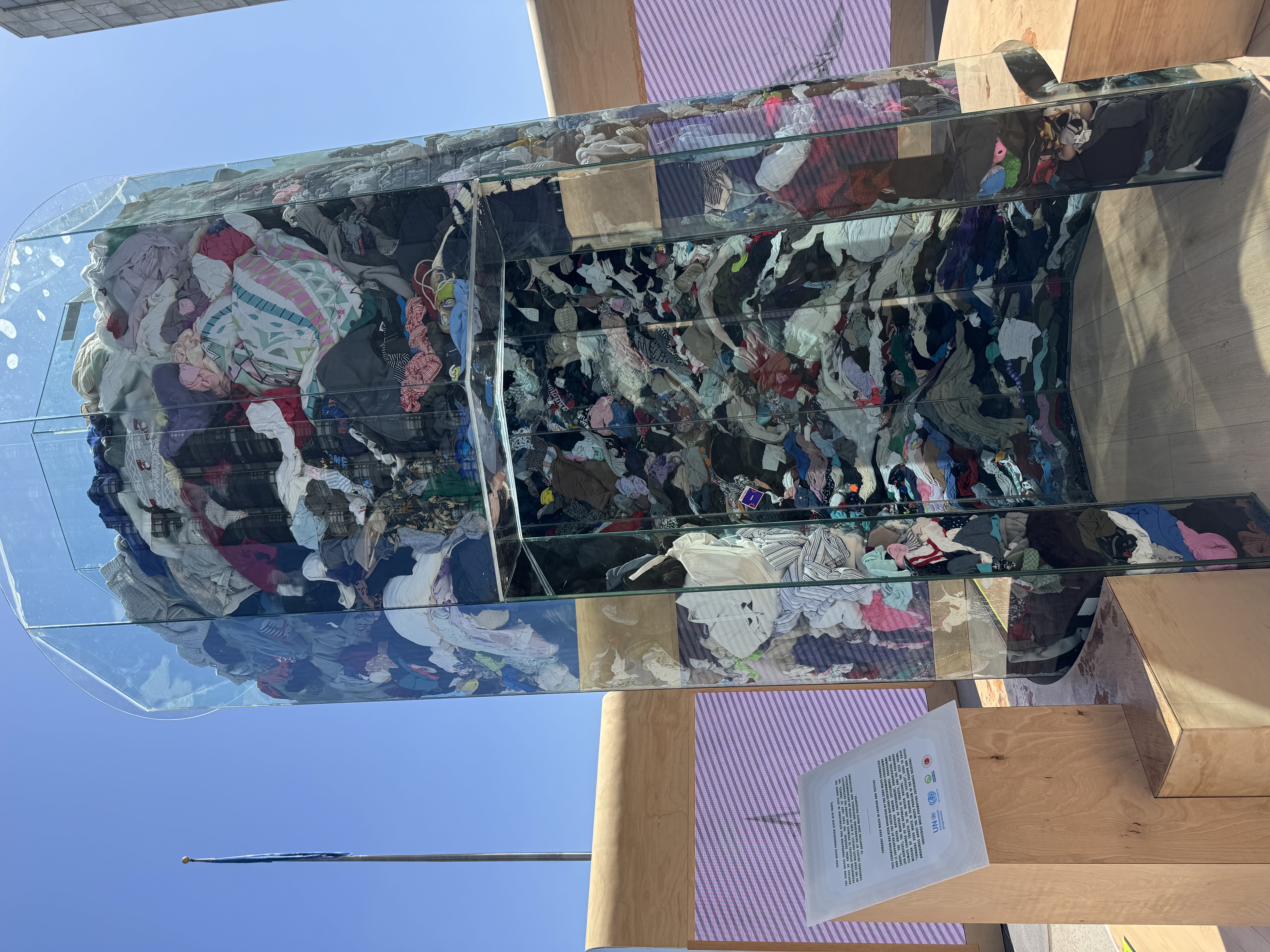
The following is a firsthand account from Bond4’s Outreach Director, a former U.S. diplomat who served at the U.S. Mission to the United Nations in New York. During her posting, she frequently explored the rotating exhibitions in and around the UN Secretariat. In 2025, an exhibition marking the International Day of Zero Waste focused on clothing and textile waste, prompting her to look more closely at the growing environmental and waste-management challenges created by fashion overproduction.
I am a former U.S. diplomat, and during my Foreign Service career, I had the privilege of serving at the U.S. Mission to the United Nations in New York.
My job was to represent and advocate for U.S. policies at the world's premier international forum. But during my time at the UN, I also discovered another part of the institution that I loved: its constantly changing exhibitions.
Between meetings and diplomatic engagements, I would often take time to walk through the displays in and around the Secretariat building. They covered everything from climate change and human rights to poverty, development, and other global challenges.
One exhibition in 2025 caught my attention in a different way.
It was about clothing waste.
The exhibition, “We Have Enough,” was displayed in the UN Gardens in connection with the 2025 International Day of Zero Waste, whose theme was “Towards Zero Waste in Fashion and Textiles.” Organized by the Zero Waste Foundation in collaboration with UNEP and UN-Habitat, the exhibition explored the impacts of overconsumption and showcased ideas for more sustainable living.
And its message was remarkably simple:
We have enough clothes.
So why are we still making so many more?
The Problem Starts Before the Clothes Reach Our Closets
When we think about clothing waste, it is easy to focus on what happens when we clean out our closets.
An old shirt goes into a donation bag. A pair of jeans gets thrown in the trash. A sweater that has gone out of style sits untouched in the back of the closet.
But the problem starts much earlier.
The fashion industry produces enormous quantities of clothing, often at very low prices and at a pace designed to keep consumers buying. According to UNEP, clothing production doubled between 2000 and 2015, while the duration of garment use decreased by 36 percent. Today, approximately 92 million tonnes of textile waste are generated globally every year.
The United Nations has put the scale into an even more striking perspective: every second, the equivalent of one garbage truck full of clothing is sent to landfill or incinerated.
A garbage truck. Every second.
And that is not simply a waste-management problem. It is a sustainability problem.
The Environmental Cost Starts Before the Trash Can
Every garment requires resources.
Cotton requires land and water. Synthetic fabrics such as polyester are made from fossil-fuel-derived materials. Dyes and finishing processes can require chemicals and energy. Manufacturing, transportation, packaging, and retail all add to a garment's environmental footprint.
The UN's 2025 International Day of Zero Waste messaging highlighted the enormous resource demands and environmental impacts associated with today's fashion system, including its contribution to greenhouse gas emissions, pollution, and pressure on land and water.
When a garment is barely worn before being discarded, all of those resources were used for something that had an incredibly short useful life.
That is what makes overproduction so troubling.
The problem isn't simply that we aren't recycling enough.
We're making too much in the first place.
America's Clothing Waste Problem
The issue is particularly significant in the United States.
The latest EPA data currently available for clothing and footwear show that Americans generated approximately 13 million tons of clothing and footwear waste in 2018.
Only about 13 percent was recycled.
Approximately 9.1 million tons ended up in landfills, while another 2.2 million tons were combusted with energy recovery.
Looking at textiles more broadly, the EPA estimated that 17 million tons of textiles entered the U.S. municipal solid waste stream in 2018. Of that, 11.3 million tons were landfilled.
There is an important caveat: EPA's end-of-life estimates do not include textiles that are reused through donations, resale, or other channels before they officially enter the waste stream.
That means donating or reselling clothing can make a meaningful difference by extending its useful life.
But eventually, many garments still become waste.
Why Textiles Are Difficult for Waste Managers
From a waste-management perspective, clothing presents some unique challenges.
A single garment can contain cotton, polyester, nylon, elastane, dyes, buttons, zippers, coatings, and other materials.
Those combinations can make recycling difficult.
Blended fabrics are particularly challenging because separating different fibers can require specialized technologies and infrastructure. Synthetic fabrics also contain plastics, adding another dimension to the problem.
And while donating clothing is generally preferable to throwing it away, donation systems have limits.
Charities and secondhand stores cannot use every item they receive. Low-quality or damaged clothing may have little resale or reuse value, meaning it can ultimately become waste anyway.
The problem can also cross borders. UNEP has warned that discarded clothing can end up in countries where waste-management infrastructure is not equipped to handle the volume, contributing to dumping and burning.
So the waste doesn't necessarily disappear.
It may simply move somewhere else.
From Fast Fashion to Circular Fashion
Our current model is largely linear:
Make → Buy → Wear → Throw Away
A more sustainable model looks very different:
Make → Buy → Wear → Repair → Reuse → Resell → Recycle
That means designing clothing to last longer. Choosing materials that can be recovered. Repairing garments instead of automatically replacing them. Expanding resale and secondhand markets. And developing better systems for collecting and recycling textiles at the end of their useful lives.
It also means recognizing something that is true for virtually every waste stream:
Waste management begins long before something becomes waste.
The decisions made during design, manufacturing, purchasing, and consumption determine what eventually arrives at a landfill, incinerator, recycling facility, or reuse center.
Better waste management matters.
But prevention is even better.
What Can We Do?
We don't need to stop enjoying fashion.
We can simply become more thoughtful about what we buy and what happens to it afterward.
Buy less. Before purchasing something new, ask whether you really need it and whether you'll wear it many times.
Choose quality. A garment that lasts years is far better than one that lasts only a few months.
Repair it. A small tear, missing button, or broken zipper doesn't have to mean the end of a garment.
Shop secondhand. Thrift stores, consignment shops, and resale platforms give existing clothing another life without requiring new production.
Donate thoughtfully. Local shelters, community organizations, schools, and nonprofits may be able to put gently used clothing directly into the hands of people who need it. Check what organizations actually accept before dropping off a bag.
Organize a clothing swap. That dress you never wear might be exactly what someone else has been looking for.
Recycle responsibly. If a garment truly has reached the end of its useful life, look for textile recycling options in your community. Don't assume clothing belongs in the regular curbside recycling bin.
We Have Enough
I think back to that exhibition at the UN from time to time.
During my diplomatic posting, I saw exhibitions about climate change, poverty, conflict, development, and countless other global challenges. The clothing exhibit stood out because the issue felt so personal.
We all have a closet.
We all buy things.
And most of us have clothes we rarely wear.
The good news is that this is one global environmental problem where individual choices really can add up.
We don't need another shirt just because it is inexpensive. We don't need to replace something simply because a new trend has arrived. And we don't have to throw something away simply because we no longer want it.
Sometimes the most sustainable choice is the simplest one:
Wear what you already own.
The message of the UN exhibition was simple:
We have enough.
Now we need to get better at making what we have last.
At Bond4Waste, we believe the future of waste management isn't simply about collecting more waste. It's about building smarter systems that help communities and businesses prevent waste, keep materials in use, and manage less of what ultimately ends up in the waste stream.
Related reading
How Patagonia Is Tackling the Problem of Clothing Waste
We’ve talked a lot about textile overproduction and the enormous amount of clothing that ends up as waste. But there is another side to the fashion story: what happens when a comp…

Documentary Review: "Buy Now!" Reveals the Hidden Cost of Our Shopping Addiction
Continuing on the theme of textile overproduction and waste, as mentioned in our last newsletter , we wanted to take a closer look at a documentary that asks a bigger question: Wh…
UNGA 2026 and the Sustainability Goals: It’s Time to Talk About Waste
Every September, the world’s attention turns to New York as leaders gather for the United Nations General Assembly. This year, as UNGA 2026 brings renewed focus to the Sustainable…