What is pool service route software?
Pool service route software generates the week’s routes from each account’s service cadence instead of having someone rebuild them by hand. It hands the day to a technician on a phone, records a proof-of-visit at every stop, carries repair and seasonal work orders alongside the recurring visits, and bills the monthly agreement from work that actually happened.
The tell for a real route system is what happens when you add fourteen accounts and drop nine. If that means an afternoon of manual re-sequencing, you have a calendar. If the routes regenerate from cadence and geography, you have route software.
A pool route is the most repetitive shape in field service
Nothing else in service operations repeats this tightly: the same stops, the same weekday, a short visit each, at high density, with the customer almost never present. Two consequences follow, and they drive every requirement on this page.
- Density is the whole margin. Stop count is a vanity number. What decides whether a technician day pays is how little driving sits between the stops.
- Nobody watches you work. Because the customer is at work when you are at their pool, the record of the visit is the only thing they experience. Proof is not paperwork here; it is the deliverable.
Terms worth being precise about
| Term | What it means in a pool route operation |
|---|---|
| Route density | How many serviceable stops sit within a short drive of each other. Density, not stop count, decides whether a technician day is profitable. |
| Stop record | The evidence that a visit happened: who, when, where, what was found, and what was done. In a business where customers are rarely home, this is the product. |
| Coverage day | A day when someone other than the usual technician runs the route. Everything the regular technician knows from memory has to already be written down. |
| One-off work order | Repair, equipment, or seasonal work scheduled outside the recurring maintenance visit and billed separately from the monthly rate. |
| Recurring cadence | The interval an account is serviced on. Routes are generated from cadence rather than rebuilt by hand each week. |
The stop record has to be legible to a stranger
Design the record for the coverage day, not the normal day. The regular technician carries a route in their head: which gate sticks, which dog is loose, which client wants the invoice emailed to a spouse. That knowledge is worth nothing on the day they are sick, on vacation, or gone to a competitor — which is exactly when service quality gets judged.
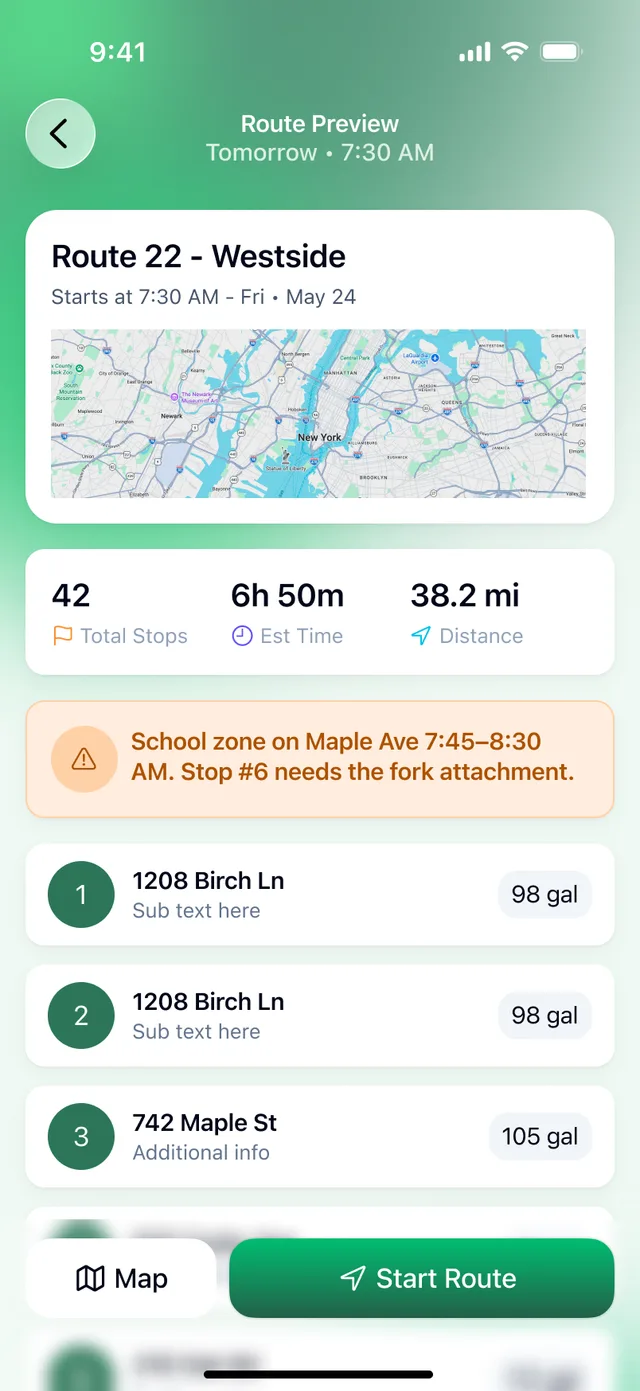
In Bond4Waste, site details live on the customer and site record where any assigned technician sees them, and each visit writes a completion with a timestamp, GPS location, photos, and notes into the service history. The native B4W Driver app is offline-first, so a stop behind a house with no signal still records normally and syncs when coverage returns.
Per-stop readings: what is captured and what to verify
This is the honest boundary between generic route software and a pool vertical product, so here it is as a table rather than a paragraph you have to squint at.
| What you need at the stop | Status | Detail |
|---|---|---|
| That the visit happened, when, and where | Captured | Completion timestamp and GPS location recorded in the driver app |
| Which technician performed it | Captured | Route assignment under role-based access control, with an audit log |
| What the technician found | Captured | Photos and notes attached at the stop |
| Site access details | Captured | Kept on the customer and site record so any technician sees them |
| Customer acknowledgement | Captured | Signature collected in the app where the account requires it |
| Chemistry readings as structured fields | Verify | No purpose-built readings model — confirm where these numbers would live |
| Dosing history and trend charts per body of water | Verify | Not part of the platform — plan for a separate record if you rely on it |
| Equipment parts catalog for repairs | Verify | Not part of the platform — confirm how repair line items are built |
Repairs and seasonal work ride on top of the weekly route
A pool business runs two businesses with different economics through the same truck. The recurring maintenance visit is flat-rate and predictable. Repairs, equipment replacement, and seasonal open and close work are per-job, higher margin, and scheduled around the route rather than into it. Bond4Waste keeps them as separate work orders against the same customer and site, which is what makes account-level profitability visible once the extras are counted.
Dispatch can slot that work into the day and reassign it live when a repair runs long, with the technician notified automatically instead of by phone. The general mechanics are on the routing and dispatch page.
Billing a flat monthly rate plus everything else
Invoices are generated from completed work with line items, taxes, and totals, then held for billing review before they go out. The customer is notified by email and can pay through the billing portal by credit card, ACH, or check, with automatic follow-up on overdue invoices. Customers, invoices, and payments sync two-way with QuickBooks Online, so a monthly book of several hundred small invoices does not become a data-entry job.
Related route operations
The nearest neighbour is pest control route software, which shares the recurring-cadence shape and diverges on application records. For seasonal work that activates on weather rather than schedule, see snow removal dispatch software. The category across trades is covered in route-based service software, and the platform underneath in scalable waste management software.
Frequently asked questions
What is pool service route software? Pool service route software generates weekly maintenance routes from each account’s service cadence, delivers the day to a technician on a phone, records a proof-of-visit for every stop, carries repair and seasonal work orders alongside the recurring visits, and bills the monthly agreement from completed work. Bond4Waste provides that workflow as route-based service operations software.
How is a pool route different from other service routes? It is the most repetitive route shape in field service. The same accounts come back the same day every week, at high stop density, with short visits and almost no customer contact. That means two things dominate the software requirement: route density has to be manageable as accounts are added and dropped, and the stop record has to be complete enough that a substitute technician can run the route without calling anyone.
Can Bond4Waste record pool chemistry readings at each stop? Not as a structured chemistry form. Bond4Waste captures a timestamped, GPS-located completion with photos, technician notes, and a signature where one is collected, which covers proof that the visit happened and what was found. It does not ship a per-body-of-water readings model with dosing history and trend charts. If chemistry history is central to how you serve and defend accounts, make that the first question in a demo.
How do repairs and seasonal work fit alongside the weekly route? As separate work orders against the same customer and site. A pool business runs two kinds of work with different economics: the recurring maintenance visit billed at a flat monthly rate, and repair, equipment, or open and close work billed per job. Keeping them as distinct work orders on the same customer record is what lets you see which accounts are actually profitable once the extras are counted.
Is Bond4Waste built for pool service companies? Bond4Waste is route-based service operations software whose customers today are waste haulers and municipalities. The scheduling, dispatch, mobile field capture, proof-of-service, and billing layers apply directly to a weekly pool route. Pool-specific tooling — chemistry readings, dosing calculators, and parts catalogs for equipment repair — is not part of the platform, and this page says so rather than implying otherwise.