Introducing Bond4Waste: Let’s Put Waste on Autopilot
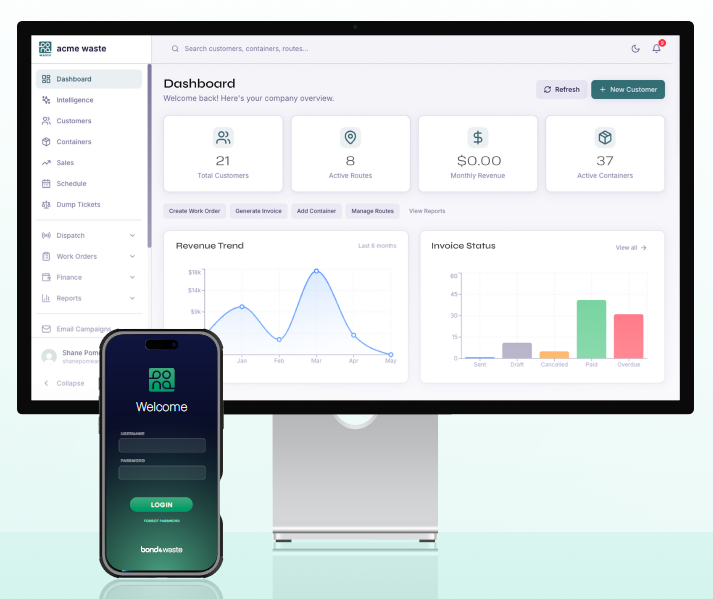
We started Bond4Waste to solve a problem we’ve all felt: the daily drag of manual tasks that slows haulers, recyclers, and MRFs. Today, we’re opening the doors. Our aim is straightforward — turn back-office work into background automation so you can scale, improve service, and focus on what you do best.
Why we built Bond4Waste now
The industry has modern trucks, smarter cameras, and better scales — but the systems that connect the work are still stitched together with emails, spreadsheets, and midnight reconciliations. We keep hearing the same list: price changes that don’t flow through, tickets that don’t match, photos living on phones, EDI that’s touchy, and month-end turns into a fire drill.
We built Bond4Waste as an operating backbone across order-to-cash and field operations. Not another bolt-on, but a connected layer that standardizes data from the truck to the tip floor and automates the repetitive decisions that eat up your day. Opinionated where it should be, configurable where it must be. The goal isn’t flashy dashboards that do the same thing as your last software. It’s fewer phone calls, fewer touches, faster cash, and clean trails.
For haulers, that means less time chasing proof and more time on service. For MRF operators, it means matching inbound streams, bale grades, and customers without guesswork. For sustainability teams, it means diversion, contamination, and material reporting you can trust — without begging three different departments for CSVs.
What changes on day one
Here’s what teams can automate immediately with Bond4Waste:
Order capture and pricing
Dispatch and service verification
Scale tickets and disposal fees
Billing and cash
Recycling and MRF workflows
Reporting that’s practical
Under the hood, Bond4Waste standardizes the data model across accounts, assets, materials, sites, contracts, tickets, and invoices. That’s what makes the automation hold up in real life — the truck photo lines up with the stop, the stop with the ticket, the ticket with the invoice, and the invoice with the cash application.
How we roll it out without breaking your day
We meet you where you are. No rip-and-replace.
Integrations that matter
Data migration and onboarding:
We import customers, contracts, pricing, assets, and site rules from the sources you already trust
Parallel run playbooks so teams can validate side-by-side before flipping the switch
Role-based training focused on what each person actually does: CSRs, dispatch, drivers, accounting, MRF floor
Reliability and control
Role-based permissions and auditable changes across pricing, tickets, and invoicing
Uptime and monitoring designed for operations that start before sunrise
What’s next: deeper vision for contamination reduction with camera partners, smarter exception handling with assistive AI, and out-of-the-box sustainability reporting mapped to common frameworks — all grounded in the same principle: automate the repetitive, surface the exceptions, and keep humans in control where judgment matters.
We’re building Bond4Waste with operators, not in a vacuum. If you see a faster path from call-to-cash or a workflow we should snap into, tell us. The mission is simple: radically shrink the cost and friction of running a waste business so you can grow routes, improve recovery, and raise service quality without adding headcount.
See you on the route.
Book A Demo with us HERE
Related reading

Looking for a TrashFlow Alternative? Here's What Modern Waste Operators Should Know
If you're searching for a TrashFlow alternative, chances are you're not looking to replace software just for the sake of it. You're probably trying to solve a problem. Maybe dispa…

A Generational ownership transition in waste management is happening... And the data proves it.
The industry just validated a thesis many haulers live every day: the work is growing, the workforce isn’t, and the only scalable answer is technology. SWANA’s Young Professionals…

How AI Turns Waste Data Into Profit: Analytics, Forecasts, and Operational Intelligence
Margins in hauling and recycling don’t come from shiny dashboards—they come from better decisions at the stop, the scale, and the line. The good news: AI is finally good enough to…