Waste Technology Is Consolidating. Here's What Haulers Should Look for Next.
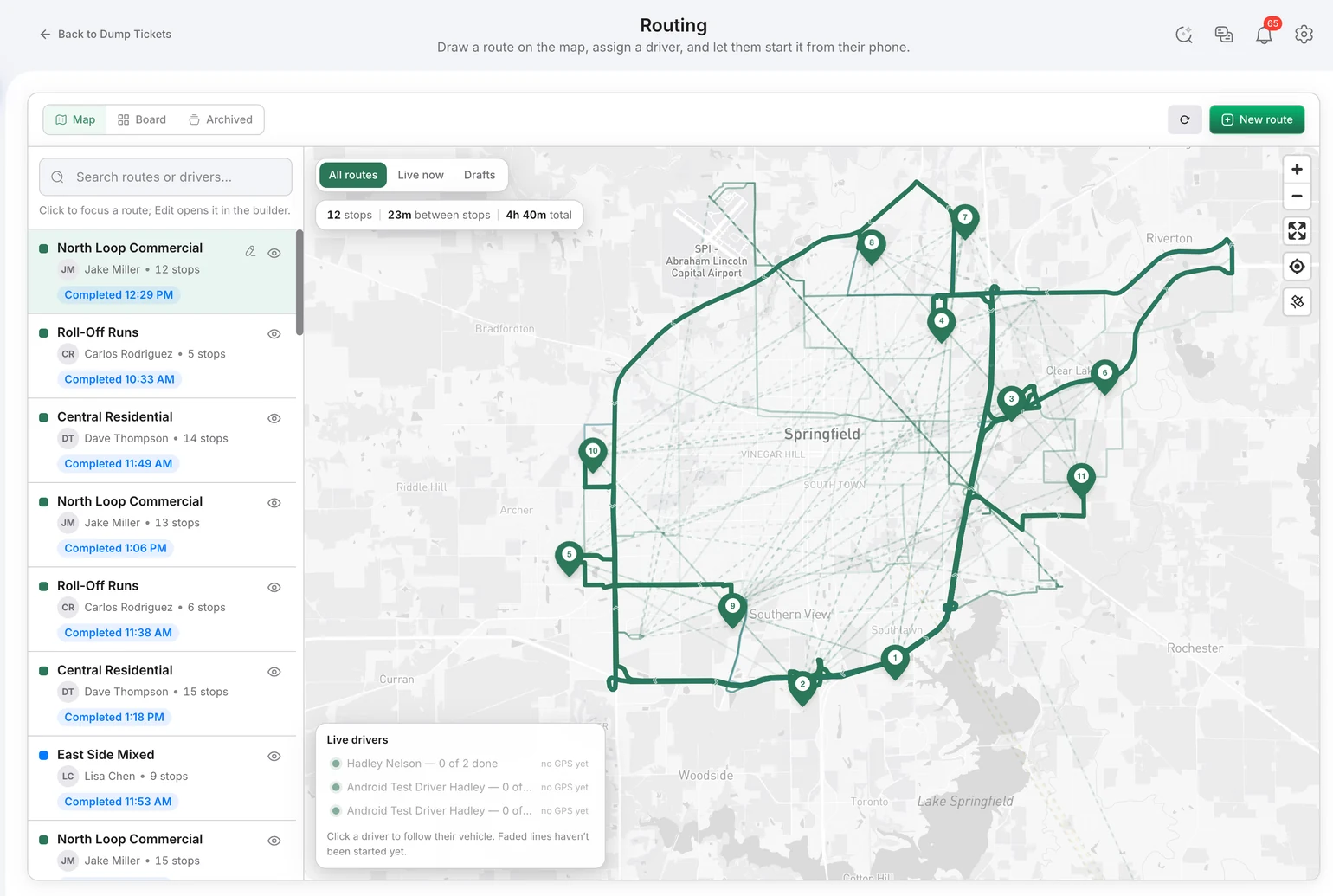
As waste technology companies bring capabilities together and new collection equipment enters the market, haulers face a bigger question: Does their software simply run the operation, or does it help them run it better?
Waste management is becoming a more technology-driven business. Dispatchers coordinate complex routes, billing teams manage thousands of customer accounts, and fleet managers track vehicles, service performance, and operating costs. Each system generates information that can help a company operate more efficiently.
But having more technology doesn't always mean having a clearer picture of the business.
Recent developments at Kanopy Technology and Kollekt highlight how the industry's technology landscape is changing. For haulers, these changes offer an opportunity to reconsider not just which tools they use, but how effectively those tools work together.
At Bond4Waste, we believe the next step is connecting operational data to better business decisions.
A Changing Waste Technology Landscape
In September 2026, Recycle Coach and Re-TRAC came together under Kanopy Technology, a new parent company designed to connect capabilities across waste and recycling. Recycle Coach focuses on resident education and recycling guidance, while Re-TRAC provides waste and recycling data collection and reporting. Kanopy also announced a strategic partnership with Prairie Robotics, which uses AI-enabled cameras to identify recycling contamination, and plans to introduce Curb Coach for broader waste service information.
The development reflects a challenge across the industry: information about waste services is often spread across municipalities, haulers, agencies, and technology providers. Connecting these capabilities could make it easier to coordinate services and manage information.
Read more in Waste Dive's coverage of Kanopy Technology.
Meanwhile, Kollekt launched at RCon 2026 under CEO Don Ross, an industry veteran with nearly four decades of experience. Backed by the Kirchhoff group of companies, Kollekt aims to bring collection equipment and technology to the North American market.
Kollekt is an equipment provider rather than a dispatch or billing software company, but its launch adds to a wider conversation about modernizing collection operations.
The common thread is that waste management businesses need technology that supports increasingly complex operations. For haulers, that means looking beyond individual products and considering how the pieces of their technology stack fit together.
The Problem: Dispatch and Billing Don't Tell the Whole Story
Dispatch and billing software are essential to a hauling business. They help coordinate pickups, manage customer accounts, schedule services, and generate invoices. Without them, daily operations would quickly become difficult to manage.
But these systems primarily support specific workflows. They don't always provide a complete view of operational performance.
Consider a commercial hauler with hundreds of customers. Its dispatch system records completed services, its fleet software tracks GPS data, and its billing platform generates invoices. Each system may be doing its job correctly, yet management could still struggle to answer several important questions:
Are all completed services being billed correctly?
Which customers or routes are costing more to serve than expected?
Where are recurring delays affecting productivity?
Which accounts have repeated service issues?
Are operational costs rising faster than revenue?
Answering these questions may require employees to pull reports from multiple systems, reconcile spreadsheets, and investigate discrepancies manually.
That creates a gap between collecting information and using it to improve the business.
The challenge isn't necessarily a lack of software. It's a lack of connected operational intelligence.
Where Bond4Waste Fits In
Bond4Waste was built to help waste haulers and recyclers close that gap.
Rather than asking companies to replace their existing dispatch, billing, or fleet systems, Bond4Waste's AI-powered operational intelligence works with information from across their operations to help uncover patterns, identify discrepancies, and support better decisions.
Think of it as a layer of intelligence that complements the software haulers already use.
Here are four ways that can matter to the bottom line.
1. Protect Revenue With Better Visibility
A completed service doesn't automatically guarantee that the correct charge reaches an invoice.
By connecting relevant service records, route information, and billing data, Bond4Waste can help identify potential under-billing, missed charges, and discrepancies that deserve investigation.
For haulers operating on tight margins, identifying revenue that may otherwise go uncollected can be just as important as winning new customers.
2. Understand the True Cost of Serving Customers
Revenue alone doesn't tell a hauler whether an account is profitable.
A customer may generate substantial income but require frequent pickups, additional mileage, special handling, or repeated service visits. Understanding those costs helps operators evaluate pricing, service frequency, and resource allocation.
Bond4Waste's analytics can help operators connect operational activity with cost-to-serve questions, giving management a clearer basis for evaluating performance.
3. Identify Route Inefficiencies
Routes rarely perform exactly as planned every day. Traffic, service delays, changing customer needs, and operational exceptions can all affect productivity.
When route records and GPS information are analyzed together, recurring patterns may reveal opportunities to investigate excessive mileage, inefficient stops, or persistent delays.
The objective isn't simply to move trucks faster. It's to help operators understand where time and resources are being lost and where changes could make a measurable difference.
4. Turn Scattered Data Into Actionable Insights
Waste businesses generate information across dispatch, billing, fleet operations, facilities, customer service, and compliance.
Bond4Waste helps bring relevant information together so managers can investigate problems that might be difficult to see when each dataset is viewed separately.
AI can help surface patterns and potential anomalies, but the value comes from what operators do with those insights: investigate discrepancies, adjust workflows, improve service, and make better-informed business decisions.
What Haulers Should Look for in Their Next Software Decision
Whether a company is choosing dispatch software for the first time or considering replacing an established platform, the decision deserves a broader perspective.
Prioritize integration. Ask how easily the platform can exchange information with accounting, fleet, customer service, and analytics tools.
Look beyond the feature list. A system may offer excellent scheduling and billing capabilities without answering deeper questions about profitability, productivity, and operational performance.
Consider the total cost. Subscription fees, implementation, training, integrations, and the disruption associated with switching systems all matter.
Plan for growth. The technology stack should accommodate additional customers, trucks, service lines, and reporting needs without creating unnecessary complexity.
Make existing data work harder. Before investing in another operational system, consider whether the information already being collected could provide more value through better analysis.
Not every hauler needs to consolidate every function into a single platform. The better approach is to ensure each tool serves a clear purpose and that important information can move between systems.
The Future Is More Than Software
The developments at Kanopy Technology and Kollekt show that innovation in waste management spans resident engagement, recycling data, collection equipment, and operational technology.
For haulers, the opportunity extends beyond adopting the newest platform or purchasing new equipment. It's about building an operation where technology provides more than records of what happened. It helps explain why it happened, where money may be leaking, and what to do next.
That is where Bond4Waste comes in.
Dispatch software helps manage the work. Billing software helps charge for it. Bond4Waste helps haulers understand the operational data behind the business.
In an industry where margins, efficiency, and service reliability matter every day, that additional visibility can make a meaningful difference.
The future of waste technology isn't just about adding more software. It's about getting more value from the systems and data haulers already have.
Related reading

Looking for a TrashFlow Alternative? Here's What Modern Waste Operators Should Know
If you're searching for a TrashFlow alternative, chances are you're not looking to replace software just for the sake of it. You're probably trying to solve a problem. Maybe dispa…

A Generational ownership transition in waste management is happening... And the data proves it.
The industry just validated a thesis many haulers live every day: the work is growing, the workforce isn’t, and the only scalable answer is technology. SWANA’s Young Professionals…

Univerus scoops up FleetMind: What this consolidation means for your routes, trucks, and data
Fleet software just got more consolidated. Univerus is buying FleetMind’s assets from Safe Fleet, and that has real day-to-day implications for haulers running smart trucks, integrated cameras, and billing workflows.