Permanent Fire Season: Batteries Have Changed the Risk Math for MRFs and Haulers
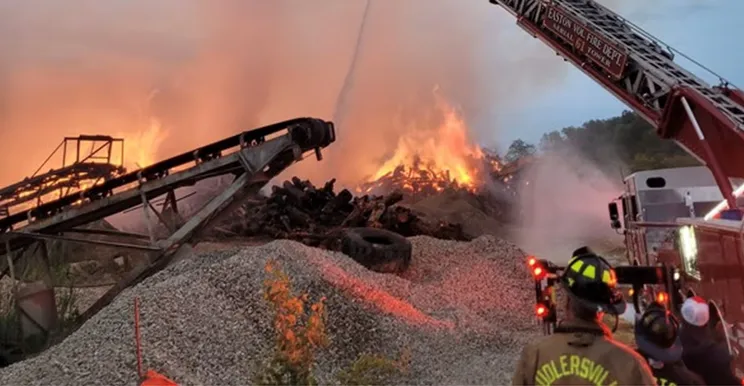
The June Fire Report from Waste360 lays down a marker: facility and fleet fires aren’t a blip; they’re the operating backdrop. Last year teased a lull, then 2025 reminded everyone how quickly the needle swings back. If you run a MRF, transfer station, landfill, or a collection fleet, treat fire risk like weather — constant, predictable in pattern if not timing, and something you engineer and dispatch around every single day.
What Waste360 is flagging — and why it matters
Waste360’s June 2026 Fire Report concludes the waste and recycling sector is in a “permanently elevated fire-risk environment,” noting that a brief dip in incidents last May was followed by a sharp resurgence through 2025. The drivers are familiar on the floor: surging lithium-ion batteries in household and commercial streams, denser stockpiles, more after-hours smolder events, and hotter summers amplifying everything. The ignition points span the system — collection vehicles taking a thermal runaway mid-route, transfer stations catching smolders in the pile, and MRF lines flashing when a battery or propane cylinder meets friction.
This isn’t just a “safety” headline. It’s an insurance and uptime story. Underwriters have tightened terms across recycling classes, increasingly requiring thermal detection, automated suppression, and documented SOPs before they’ll bind coverage — and some operators are finding fewer carriers willing to quote at all. Downtime from a single incident can erase a month’s margin.
The new cost curve: premiums, capex, and operational drag
As reported by Waste360, the throughline is clear: risk is structural, not episodic. That pushes costs into three buckets operators actually feel:
- Insurance: Premiums and deductibles trend up; exclusions expand. Carriers want proof of detection, separation distances, pile management, and response protocols. Some are asking for after-hours remote monitoring with event logs you can export.
- Capital: Thermal cameras, line- or area-based suppression, fixed fire monitors, firewater improvements, battery-safe quarantine containers, sealed hot-load boxes, and better inbound screening all move from “nice-to-have” to required kit. You may also be resizing bunkers and shortening dwell time to keep fuel load down.
- Operations: Fire prevention adds friction. More load rejections, more slowdowns to isolate suspect material, driver training time, and dispatch decisions when a truck smells smoke. When you don’t engineer for those moments, the friction becomes chaos — blocked scales, panicked routing, and costly false alarms.
Practical moves to make this week, not next year
We don’t need to wait for a code revision to act. The operators staying out of the news are standardizing a handful of moves now:
- Inbound controls that bite: Battery and HHW language in contracts, posted signage on boxes and routes, and a real surcharge path for contamination. Give generators a battery alternative and then enforce.
- Hot-load SOPs: Pre-approve safe dump pads, foam/wetting agents staged, and a dispatch rule that tells a driver and supervisor exactly where to go and who to call the moment there’s smoke. Don’t leave this to judgment.
- After-hours coverage: Thermal analytics on key zones with auto-escalation to on-call staff and direct tie-in to the local fire department’s pre-plan. Weekends are when smolders turn into news helicopters.
- Pile and bale discipline: Smaller piles, clear aisles, max dwell times, and no “temporary” storage in dead corners. If the forklift can’t get in, the hose definitely can’t.
- Data that earns you insurance credit: Document near-misses, drills, and response times; save video/thermal clips; log route hot-load events with GPS and timestamps. Carriers are rewarding evidence.
The Bond4 Tech Take
Permanent fire risk means you stop treating ignition as an anomaly and start building it into the playbook and the P&L. The winners will budget detection and suppression the way they budget screens and balers — as core process equipment — and wire their operations so the first minute of a hot-load event looks the same every time.
Here’s our position: by the next renewal cycle, operators without documented, tech-enabled fire programs will pay a premium tax or won’t get terms at all. Concretely, that means 1) instrument the fleet — give select routes thermal cams and a simple “smoke/odor” event code in the cab that auto-alerts dispatch; 2) geofence hot-load dump pads so a driver’s arrival triggers an on-site alarm, water/foam prep, and a time-stamped incident record; 3) embed contamination surcharges and hazardous item handling fees in contracts and billing so the economics match the risk; 4) tag generators with repeated battery violations and price or service them differently; 5) export quarterly incident and drill reports for your broker — let the data lower your rate.
Expect M&A pressure: smaller MRFs and transfer stations that can’t afford suppression or can’t secure insurance will sell. On the routing side, plan for seasonal fire weather the way you plan for snow — shift start times, pre-stage staff, and shorten dwell. Battery EPR may help over time, but operators shouldn’t wait on policy. The play now is operational discipline backed by sensors, dispatch logic, and billing that reflects the true cost of heat in the stream.
Book a meeting with Bond4Waste
Pick a time and add your details — or we'll reach out if none work.
Researched and drafted with AI assistance by the Bond4Waste editorial team. All credit for original reporting goes to Waste360.
Related reading

New ReMA fire guidance is a start. Your gatehouse, contracts, and cameras finish the job.
ReMA just refreshed its playbook for recycling fire prevention around four pillars: prevention, detection, mitigation, and education. That’s useful—but if you run a MRF, scrapyard, or transfer, the real risk control lives in your inbound controls, pricing, and real‑time response.

Lithium-ion fires aren’t a PR problem — they’re an ops problem. CDRA’s coalition push makes that plain.
A cross-association safety push signals the industry is done treating battery fires as background noise. If you run routes or a floor, the implications hit dispatch, capex, contracts, and insurance — fast.

ReMA’s fire guidance just became the industry’s new floor — operators who can’t prove control will pay
Lithium-driven fires have reshaped the risk profile of MRFs, scrap yards, and transfer sites. ReMA’s new guidance isn’t a brochure — it’s the baseline your insurer, lenders, and fire marshal will now expect to see operationalized in writing and in data.