Inside Freedom 250: Our Outreach Director's Firsthand Account from the National Mall
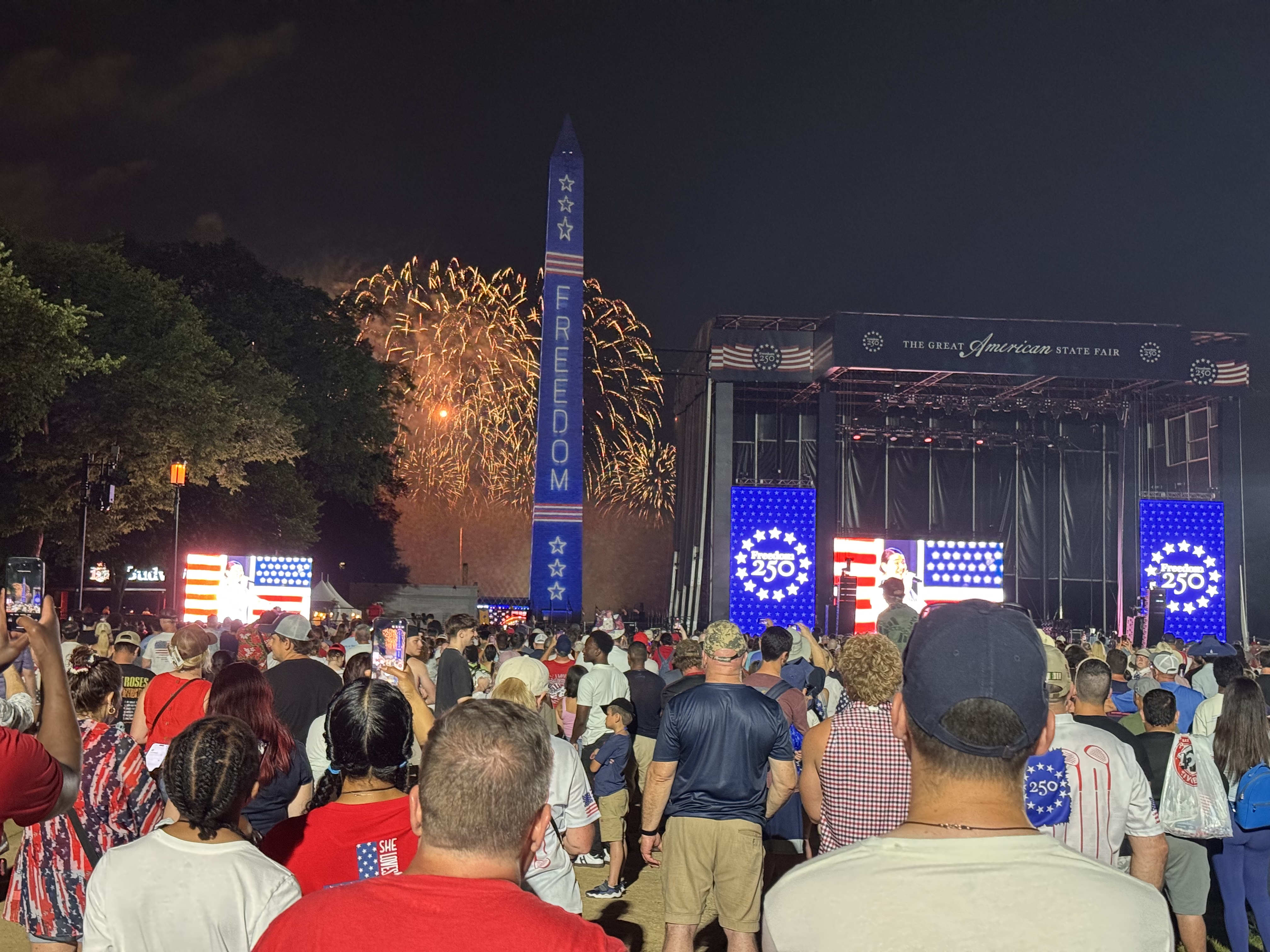
The following is a firsthand account from Bond4's Outreach Director, who attended the Freedom 250 Independence Day celebration on the National Mall in Washington, D.C., on July 4, 2026. Along with celebrating America's 250th anniversary, she found herself viewing one of the nation's largest public gatherings through the lens of waste management and operational efficiency.
Despite the rain and heavy humidity, I decided to make the trip into Washington, D.C., for the Freedom 250 celebration on the National Mall. Organizers promised one of the largest fireworks displays in American history—approximately 850,000 fireworks lighting up the nation's capital to celebrate our country's 250th birthday. Living just outside Washington, I couldn't justify missing what would likely become one of the defining public events of this historic anniversary.
Growing up in Northern Virginia, Fourth of July fireworks have always been part of my family's traditions. Over the years we've watched them from Gravelly Point, the Jefferson Memorial, the Lincoln Memorial Reflecting Pool, and even once from the Wilson Bridge after traffic came to a complete standstill. Every location brought a different view, but the feeling was always the same: celebrating America's birthday together.
This year felt different. It wasn't just another Independence Day—it was the beginning of the nation's semiquincentennial celebration.
Around 9:00 p.m., my brother, aunt, and cousins boarded Metro, knowing driving into the city simply wasn't an option. Train cars quickly filled with families dressed in red, white, and blue. Excitement was everywhere.
When we arrived at Smithsonian Station around 9:45 p.m., reality set in.
Thousands of people poured out of the station at once, only to encounter a bottleneck. One escalator carried everyone toward street level while another rain shower rolled through downtown Washington. Some people waited under cover for the rain to pass. Others joined the long, winding security line leading into the Great American Fair on the National Mall.
The line moved only a few feet every several minutes.
Military personnel, Metropolitan Police officers, National Guard members, Metro Transit Police, and event staff worked continuously to keep people moving safely. Watching them coordinate an event of this scale was impressive. But it also highlighted something every operations manager understands: once crowds reach a certain size, even the best planning reaches its limits.
Then I noticed something else.
Trash.
Empty water bottles had been stuffed into temporary fencing. Food wrappers scattered across sidewalks and grassy areas. Public trash containers overflowed almost as quickly as they were emptied.
Waste collection crews worked nonstop, hauling full 96-gallon containers onto utility carts before racing to the next location. Meanwhile, volunteers and security personnel distributed bottled water and helped elderly and disabled attendees navigate the crowds.
Everyone was doing their job.
There were simply too many people.
After nearly an hour in line, we finally entered the Great American Fair around 10:40 p.m.
The National Mall had been transformed into a massive festival. Interactive exhibits, military displays, educational booths, food vendors, stages, and informational exhibits stretched across the grounds. We found a place to spread our blanket with a clear view of the Washington Monument, where holographic projections illuminated the monument with images of the Founding Fathers, the American flag, and the Freedom 250 logo.
A large stage broadcast live entertainment across giant video screens as thousands of families settled in for the evening.
Around 11:15 p.m., President Trump addressed the crowd. His remarks centered on patriotism, honoring military veterans, celebrating America's history and resilience, and looking ahead to the nation's next 250 years. He recognized surviving World War II veterans, including Pearl Harbor survivor Ken Schubring and 109-year-old Navy veteran Arthur Rose, while emphasizing service, sacrifice, and national unity.
During the speech, he also highlighted Washington, D.C.'s recent improvements under the federal "Make the District of Columbia Safe and Beautiful" initiative, describing the nation's capital as "safe and gleaming and beautiful again."
Then came the moment everyone had been waiting for.
At approximately 11:30 p.m., the first fireworks exploded above the Washington Monument.
For nearly an hour, the night sky filled with brilliant colors, synchronized to classic American music. Families cheered. Children laughed. Thousands of phones recorded the spectacle while strangers celebrated together.
It was impossible not to feel proud.
Regardless of background or politics, moments like these remind us that public spaces still have the power to bring Americans together. Standing among hundreds of thousands of people celebrating our country's 250th birthday was something I'll never forget.
Just as the finale ended around 12:30 a.m., the rain returned, as if it was intentionally planned.
Within seconds, the crowd transformed from relaxed spectators into hundreds of thousands of people trying to leave at once.
With only limited Metro access available nearby, attendees walked toward L'Enfant Plaza through wet sidewalks now covered with discarded cups, food containers, ponchos, and water bottles.
The difference between before and after the fireworks was striking.
The waste wasn't the result of negligence.
It was the predictable outcome of moving hundreds of thousands of people through a temporary event site over the course of several hours.
As someone who works for a waste management AI startup, Bond4waste, I couldn't help but think about how technology could make events like this operate even more efficiently.
Large public gatherings create enormous operational challenges that extend far beyond crowd control. Organizers must monitor overflowing waste containers, dispatch cleanup crews in real time, anticipate congestion before it develops, and coordinate dozens of agencies working simultaneously across a sprawling venue.
These are exactly the kinds of complex operational problems where artificial intelligence is beginning to make a measurable difference.
The Freedom 250 celebration was an unforgettable experience and an incredible tribute to America's 250th birthday. But it also served as a reminder that as our public events grow larger and more ambitious, the systems supporting them must evolve as well.
Related reading

Freedom Comes With a Cleanup Crew: The Hidden Work Behind America's Biggest Holiday
Every Fourth of July ends the same way. The fireworks fade. The grills cool down. The crowds head home. And then the cleanup begins. While millions of Americans celebrate Independ…
Inside UNGA 2026: Sustainability, AI and the Future of a Changing World
The following is a firsthand account from Bond4Waste’s Outreach Director, who was in New York during the 2026 United Nations General Assembly. There is something different about N…

Waste Management Is Wildlife Management: Lessons From Glacier National Park
The most beautiful places in America have a waste problem. They just can't afford to let you see it. This week, Bond4Waste’s Outreach Director had the chance to hike through Monta…